
Zero Downtime Data Migration Plan for Live Systems
Plan a zero downtime data migration with rehearsal, replication, validation gates, a short cutover and a tested rollback before you switch traffic.
46% of more than 300 IT leaders surveyed by Caylent experienced five or more hours of downtime during their most challenging database migration, and 51% reported customer-experience problems caused directly by migration downtime, according to the published survey findings. For a live platform, that isn't just an infrastructure incident. Customers may be paying, workers accepting assignments and partners updating records throughout the move.
A credible zero downtime data migration plan separates transferring data from authorising production traffic. The copy can finish while the target remains unsafe to trust. Availability matters, but correctness, controlled routing and a usable return path decide whether the business can safely switch.
What Zero Downtime Means on a Live Platform
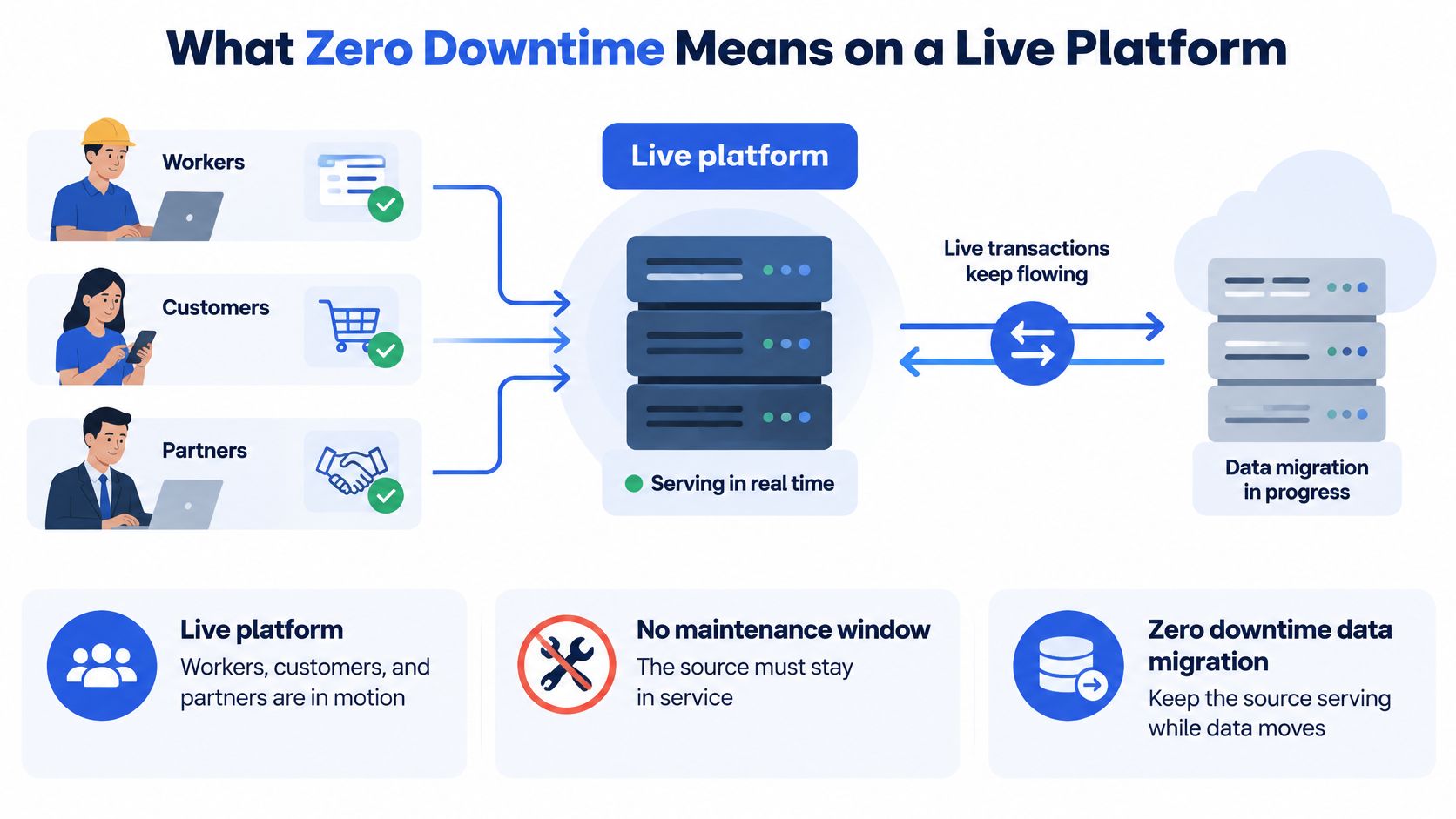
A maintenance weekend isn't a workable assumption when customers, workers and partners are mid-transaction. Zero downtime data migration means keeping the source in service while data moves, then holding the traffic switch within agreed limits for availability, latency and errors. It isn't a faster backup-and-restore exercise.
Only 6% of more than 300 IT leaders surveyed by Caylent reported zero downtime during their most challenging database migration, according to the survey coverage. That's a measured survey result, not a prediction for every platform.
The exposure extends beyond planned maintenance: 25% of respondents in a 2025 S&P Global Market Intelligence 451 Research study said extended unplanned downtime resulted from a data migration, up from 13% in 2024, as reported by 451 Research. A migration therefore needs business-continuity ownership, not just a database operator.
Publish measurable service limits
Before the first copy, the engineering lead and business owner should publish these measures:
- Availability target: Which workflows must remain usable, and what interruption budget applies?
- Latency ceiling: How slow may critical requests become before copying pauses?
- Maximum replication lag: How far behind may the target fall before the switch is blocked?
- Blocking mismatch rate: Which discrepancies stop progression, including any business invariants that require exact agreement?
- Return-to-source time: How quickly can operators restore the original route without losing accepted writes?
These are service-level objectives (SLOs), not dashboard decorations. Each needs a measurement method, an alert and an owner authorised to act.
The performance principle has a research foundation. In the 2012 Slacker prototype, a controller monitoring available migration capacity kept query latency within 10% of a specified latency target, according to the Association for Computing Machinery paper. That result concerns a tested prototype, not a production promise, but it demonstrates why migration load belongs inside the continuity definition.
Reachable doesn't mean correct
A reachable application can still show stale balances, duplicate bookings or outdated worker assignments. For managed-service businesses (MSPs), meaning non-IT service firms running multi-party platforms, those errors can affect several organisations before support receives a complaint.
Practical rule: A successful health check proves that an endpoint answered. It doesn't prove that a customer's transaction survived.
Ownership of alerts, dependencies and recovery belongs in application management planning, rather than being improvised during the switch. The plan must keep two risks separate: moving the data and deciding when production traffic may trust it.
Rehearsal Gates Before Production Traffic Moves
The runbook should be executable, not descriptive. Rehearse every row on a production-like copy, including the reverse route, and record a timed window for the complete sequence. Put a fail condition beside every gate.
An expand, migrate, contract sequence preserves compatibility while the target is populated and checked, with legacy removal deferred until after observation, as described in this legacy migration engineering guide. The important property is that operators don't destroy the previous working state before proving its replacement.
Zero-downtime migration phases and exit gates
| Phase | What runs | Exit gate | Who approves |
|---|---|---|---|
| Rehearsal | Full runbook on a production-like copy, including failback | Timed window, owners and fail criteria written down | Engineering lead |
| Compatible schema | New columns or tables the current code can ignore | Source-only application still correct | Data owner |
| Bulk snapshot | Consistent copy while the source stays open | Snapshot checkpoint recorded | Migration operator |
| Change capture | Inserts, updates and deletes after the snapshot | Lag inside the agreed gate at peak load | Migration operator |
| Backfill and reconcile | Throttled history load plus counts, hashes and totals | Mismatch under the agreed threshold | Data owner |
| Shadow reads | Target serves comparison reads; source still owns writes | Mismatch rate and latency inside the SLO | Product and engineering |
| Reversible cutover | Flag moves reads, then writes | Lag gate met and critical workflows pass | Named incident owner |
| Observation then contract | Reverse replication for a fixed window, then legacy removal | Exit criteria met, or failback completed | Same incident owner |
The engineering lead signs the rehearsal record only after operators have demonstrated both advancement and failure paths. That includes an unavailable target, a stalled capture process and a routing change that doesn't reach every application instance.
The data owner then approves compatibility. A schema deployment isn't enough: the current application must still create, update and read records correctly without relying on the target.
Approval requires evidence
The migration operator records the snapshot checkpoint before accepting the bulk-copy gate. For change capture, the operator needs a lag trace under representative peak traffic, not a quiet overnight graph.
The data owner approves the historical load using reconciliation results. Product and engineering approve shadow reads together because equivalent database responses don't necessarily produce equivalent customer behaviour. Background jobs, permissions and downstream integrations need explicit acceptance.
Each gate needs a one-page decision record containing:
- Evidence: Test output, checkpoints and the relevant monitoring interval.
- Authority: The person who may advance, plus the deputy available during the window.
- Failure response: The condition that stops work and the action that follows.
- Decision: Approval, rejection or deferred approval with unresolved items named.
The incident owner controls the traffic switch and observation exit. Legacy removal must remain a separate approval, not a cleanup task automatically triggered by a successful deployment.
A rehearsal without a named owner for the no-go decision isn't finished.
This sequence reduces the customer-visible gap. It doesn't make interruption zero. Connection handling, request draining and final validation still need a bounded window that the business accepts.
How to Replicate While the Source Stays Open
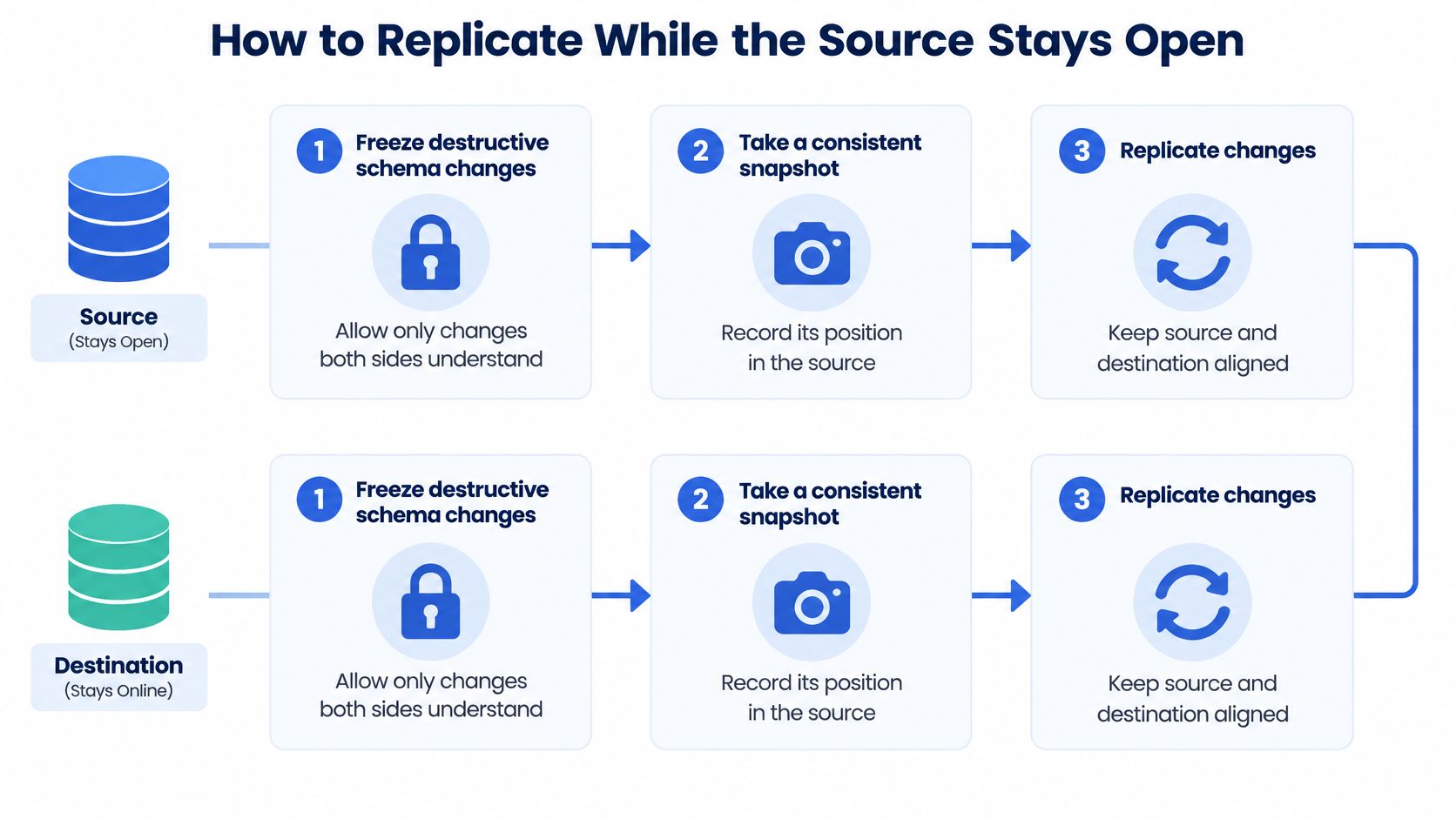
The copy has two data flows: a consistent historical snapshot and a stream of subsequent committed changes. The database migration guidance describes this snapshot-plus-change-stream pattern and distinguishes it from stopping the application during export.
A snapshot progress bar measures the historical transfer. It doesn't establish that the destination contains everything committed since the snapshot began.
Build a resumable transfer
Freeze destructive schema changes. Permit only changes that both systems and their running application versions understand. Otherwise, a dropped field or changed type can invalidate an event already waiting for replay.
Take a consistent snapshot and record its log position. The snapshot boundary must connect cleanly to subsequent changes. An ambiguous boundary can omit committed records or apply changes twice.
Load resumable batches using a stable key. Store each completed checkpoint durably. Offset-based pagination over changing records can skip or repeat rows, so use stable key ranges and repeatable batch boundaries.
Capture committed inserts, updates and deletes after the snapshot. This is change data capture (CDC). Capture must preserve the transaction and ordering semantics the application needs; an update arriving before its parent record can fail even when every event was transmitted.
Throttle historical copying when source latency or lag rises. Reduce concurrency or pause batches without discarding checkpoints. Uncontrolled backfill can consume the capacity needed to serve customers and process fresh changes.
Wait for the outstanding change stream to drain. Check source capture and target application separately. A healthy reader doesn't prove that the target has applied the events, and a completed snapshot doesn't close that gap.
Make application dual writes repairable if log capture isn't used. Require idempotency keys, deterministic upserts, retries and a repair queue. When the source commits but the target fails, an ordinary retry must not create a second transaction or conceal the missing write.
Choose the failure mode deliberately
Log-based capture is generally the stronger starting point for a high-volume platform because it follows committed source changes rather than depending on application code to complete independent writes. Its costs are operational: a capture process to monitor, schema changes to handle and sufficient log retention to replay after an interruption.
Dual writes move more responsibility into application behaviour. Every write path matters, including scheduled jobs and administrative scripts. A path that bypasses the dual-write mechanism creates divergence even when the main application behaves correctly.
The ongoing replication documentation warns that CDC latency has no service-level agreement and can rise to several minutes or longer during heavy workloads. Batch processing, index rebuilds and large extraction jobs therefore belong in the load rehearsal.
For broader planning context, CloudOrbis explains database migration services, a resource from CloudOrbis Inc. The platform-specific decision still needs to name the chosen flow, its restart boundary and the signal that pauses it.
Proof the Target Is Safe to Trust
Matching row counts are useful, but they're weak evidence on their own. A missing record and an unexpected duplicate can cancel each other out. Reordered updates can leave the right number of rows with the wrong final values.
Correctness requires defensible comparisons, not just a quiet change stream. The migration validation guidance recommends automated reconciliation across counts, deterministic hashes, duplicates, nulls, relationships and domain totals.
Correctness checks before writes move
| Check | What you compare | Pass rule | If it fails |
|---|---|---|---|
| Row counts | Source and target by table | Equal, or a difference explained by in-flight lag | Stop the switch and keep capture running |
| Checksums | Hashes of selected fields on a defined sample | Sample matches | Repair the mapping and sample again |
| Duplicates | Natural keys and idempotency keys | No unexpected extra rows | Quarantine and replay |
| Nulls and defaults | Required fields | No new nulls the source did not have | Fix the transform |
| Foreign keys | Parent and child links | No orphans | Hold the later contract phase and block affected workflows |
| Business totals | Balances, amounts or assignment counts | Match to the agreed unit | Don't move writes |
| Recent transactions | Creates and updates in the last agreed minutes | Present once lag is inside the gate | Wait or abort |
| Permissions | Allow and deny on sampled records | Same result as the source | Fix before shadow reads end |
Run these checks on every migrated entity that controls money, care, bookings or worker assignments. Use a defined sample for lower-risk entities, with the sample selection saved so failures can be reproduced.
Comparisons need a common logical point. Otherwise, an update committed between source and target queries can look like a defect. Record the checkpoint or settled comparison boundary alongside each result.
Test the journey, not just the tables
A hypothetical workforce platform illustrates the difference. A customer creates an assignment, an operator changes its location and an eligible worker reads it. The target must preserve the latest location, expose it to the right worker and deny it to an unrelated organisation.
The journey should also test cancellation. Deletes, reordered events and duplicate writes are precisely the cases that aggregate counts can hide.
Shadow reads should compare real or replayed requests while the source remains authoritative for writes. Comparison responses needn't reach customers. A mismatch above the threshold agreed during rehearsal sends the team to repair, not to a discussion about relaxing the threshold.
Stop condition: Green infrastructure dashboards cannot override a failed balance, permission or transaction check.
For troubleshooting patterns, Bridge Global's guide to how to fix migration errors provides a broader repair reference. Any correction should rerun the affected checks and the dependent customer journey.
Automated checks belong in the release process described by an agentic software development life cycle, with engineering approval retained for production decisions. A generated reconciliation script isn't sufficient evidence until its comparison rules, exclusions and failure output have been reviewed.
Cutover Window and a Tested Rollback
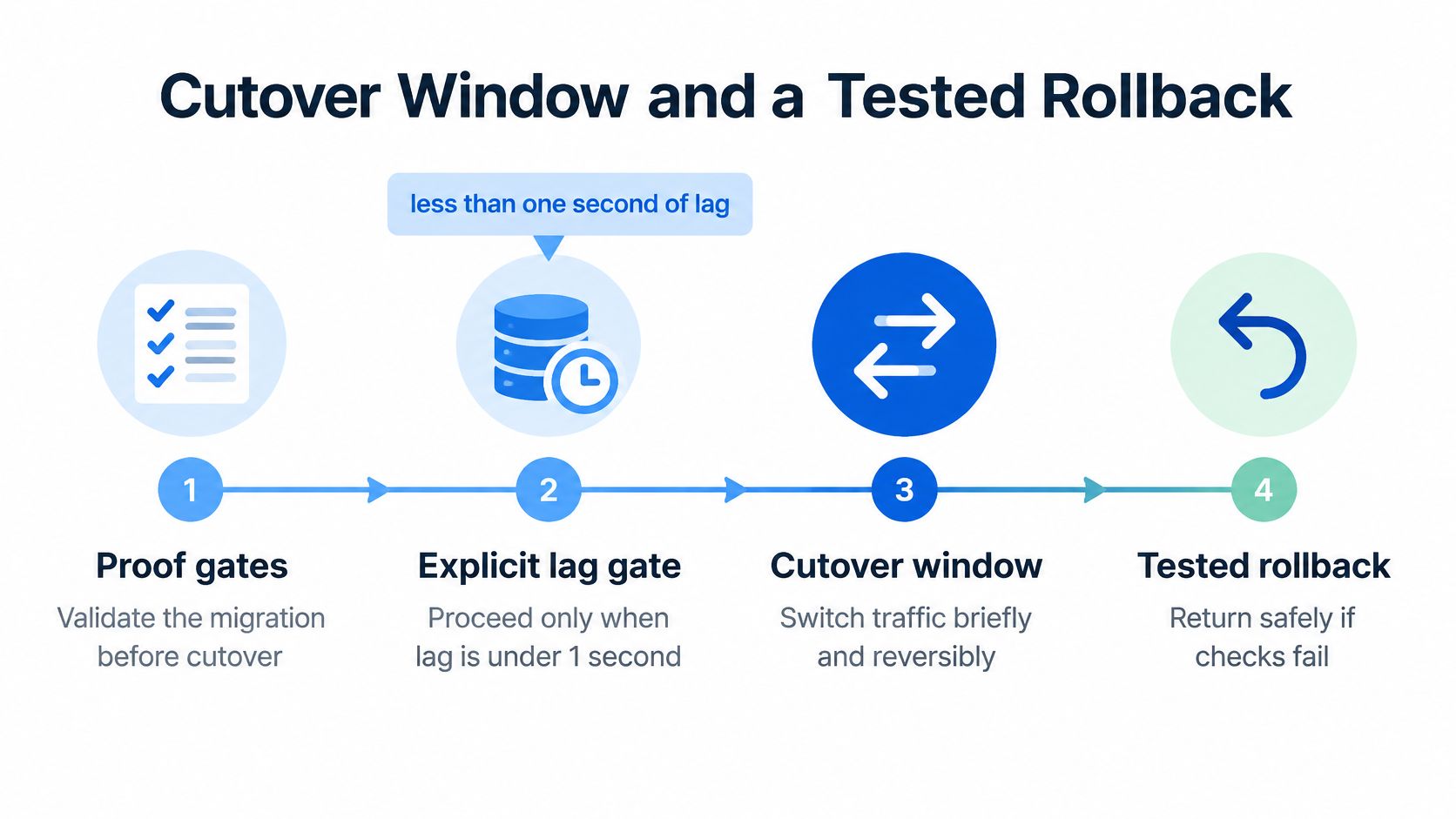
Cutover is a bounded routing decision after validation, not the migration itself. One published migration procedure used less than one second of replication lag, checked counts and checksums, tested critical queries, paused traffic for about two minutes, allowed one to two minutes for lag to reach zero and changed connection strings in about one minute, reporting a customer window under five minutes.
Those timings describe that procedure, not a reusable promise or a set of durations to add mechanically. Transaction volume, connection pools, retries and workflow checks change the achievable window.
Write the go, wait and failback script
- Go: The incident owner confirms proof gates, drains the required requests and moves reads before writes through a reversible flag. Connection pools and background workers must adopt the intended route.
- Wait: If lag exceeds the agreed gate, hold the switch and keep the source as writer. The runbook must contain a deadline after which the window is abandoned rather than extended.
- Failback: If the agreed error, mismatch or critical-workflow trigger fires after switching, fence target writes, reconcile accepted transactions and restore the source route under the incident owner's authority.
At the write-freeze point, record open transactions. Allow them to commit or abort under the rehearsed procedure, then verify that each committed business operation appears exactly once on the target before traffic resumes. An aborted transaction should remain absent, not be replayed as a successful operation.
Keep a current return path
Rollback must exist before the target accepts its first production write. The migration overview treats cutover and fallback as a distinct stage and describes a reverse-replication fallback configuration; the accompanying guidance gives an example post-cutover validation window typically lasting two to four weeks.
The window needs a named owner and measurable exit criteria. Source freshness, reverse-stream errors and replay completeness must be visible throughout it.
Reverse replication isn't permission for independent writers. Choose a single authoritative writer at every stage, fence the other side and prevent replicated events from looping back. If both sides accept unrelated edits to the same record, routing back won't resolve the conflict.
A routing flag can change the destination. It cannot reconstruct a missing transaction.
Controlled legacy system migration therefore needs a tested data-return procedure as well as a traffic-return procedure. Reverse capture adds monitoring, retention and ordering work. Remove it only after the observation criteria pass and the incident owner explicitly closes the fallback window.
Decide Whether This Cutover Is Ready
The decision should be switch, wait or simplify, not just whether the copy has finished. Engineering and operations leaders need permission to choose any of those outcomes without treating delay as failure.
Choose the safest operational outcome
Switch when rehearsal passed, lag is inside the gate, correctness checks passed, critical journeys work and the named owner can execute failback within the accepted window. Approval should reference evidence from the intended release and target configuration.
Wait when transfer is complete but integrations, schema conversion or user acceptance remain unfinished. Keep the source as the system of record and continue exercising the target without forcing a customer-facing launch.
Simplify when a short planned pause is easier to prove than prolonged parallel operation. A bounded write freeze can be safer than maintaining dual paths that the available team cannot monitor or repair.
A published summary of the migration survey identifies data transfer, target-system and integration work, and schema conversion among the time-consuming tasks. That distinction matters: completing one task doesn't establish readiness for the others.
Budget for operating both systems
Zero downtime can lengthen a project. Engineers must maintain compatible releases, investigate mismatches and rehearse failure paths while still supporting the live product. Operations needs coverage for the observation period, not just the switch.
For founders and private equity (PE)-backed businesses, this is a risk decision rather than an architectural badge. The additional work is justified when customer trust or contractual commitments cannot absorb an outage. It is a poor trade when a brief, agreed pause offers clearer correctness evidence.
Undocumented integrations make a single migration weekend particularly fragile. Keep the source authoritative until those dependencies have owners and acceptance tests.
The strongest readiness evidence is a decision record that explains why switching is safer than waiting. An honest no-go preserves the business's options. A forced launch can remove them.
Grail Computer Labs specialises in software rescue and controlled legacy re-platforming, and can scope an outcome engagement around one pre-defined, measurable migration result delivered in 4–8 weeks. Qualified clients can stop within the first 15-day trial without paying; continuous delivery means the same team keeps delivering afterwards, while GC Labs' Software Factory uses artificial intelligence agents to execute work, with GC Labs engineers making decisions and customers seeing progress. Book a call with Grail Computer Labs to review the migration runbook, correctness gates and failback plan before production traffic moves.