
8 Business Process Mapping Best Practices for 2026
Eight business process mapping best practices for accurate maps, stakeholder involvement and turning process maps into operational improvements.
A team spends several workshops mapping a process. The diagram goes into a shared drive. Months later, the operations manager still runs the work from a spreadsheet, and engineers still ask support staff how exceptions are handled.
The map was accurate in the workshop, but it never reached daily operations. Its decisions were not tied to system rules, no one owned updates, and the handoffs were not checked against real cases. When the approval policy changed, the spreadsheet changed. The map did not.
A process map becomes useful when teams can act on it. The operations owner can use it to investigate delays. An engineer can use it to rebuild a workflow. A new team member can see why an approval exists. That takes a clear record of decisions and exceptions, a way to measure the work, and a named owner who keeps the map current.
For a founder replacing a stalled development vendor, the map also needs to show which system holds the authoritative record and what happens when a customer cancels during fulfilment.
Start by documenting business workflows clearly, then connect the documentation to the people, records, and controls that keep the service running. The practices ahead follow the map through validation, decision logging, measurement, and handover, so it can guide operational change rather than end as a workshop artefact.
1. Start with a specific question and a clear process boundary
Define the decision before drawing the workflow. A map supporting a vendor transition needs different detail from a map investigating delayed approvals. Without that distinction, teams can document an entire operation without resolving the problem that justified the work.
APQC's survey identified a lack of pre-established goals as a challenge for 48% of organisations, according to its process framework challenges report. The practical response is to rank candidate workflows by customer impact, risk, measurable value and feasibility before selecting one.
A suppliers, inputs, process, outputs and customers (SIPOC) view helps establish the boundary without committing to detailed modelling.
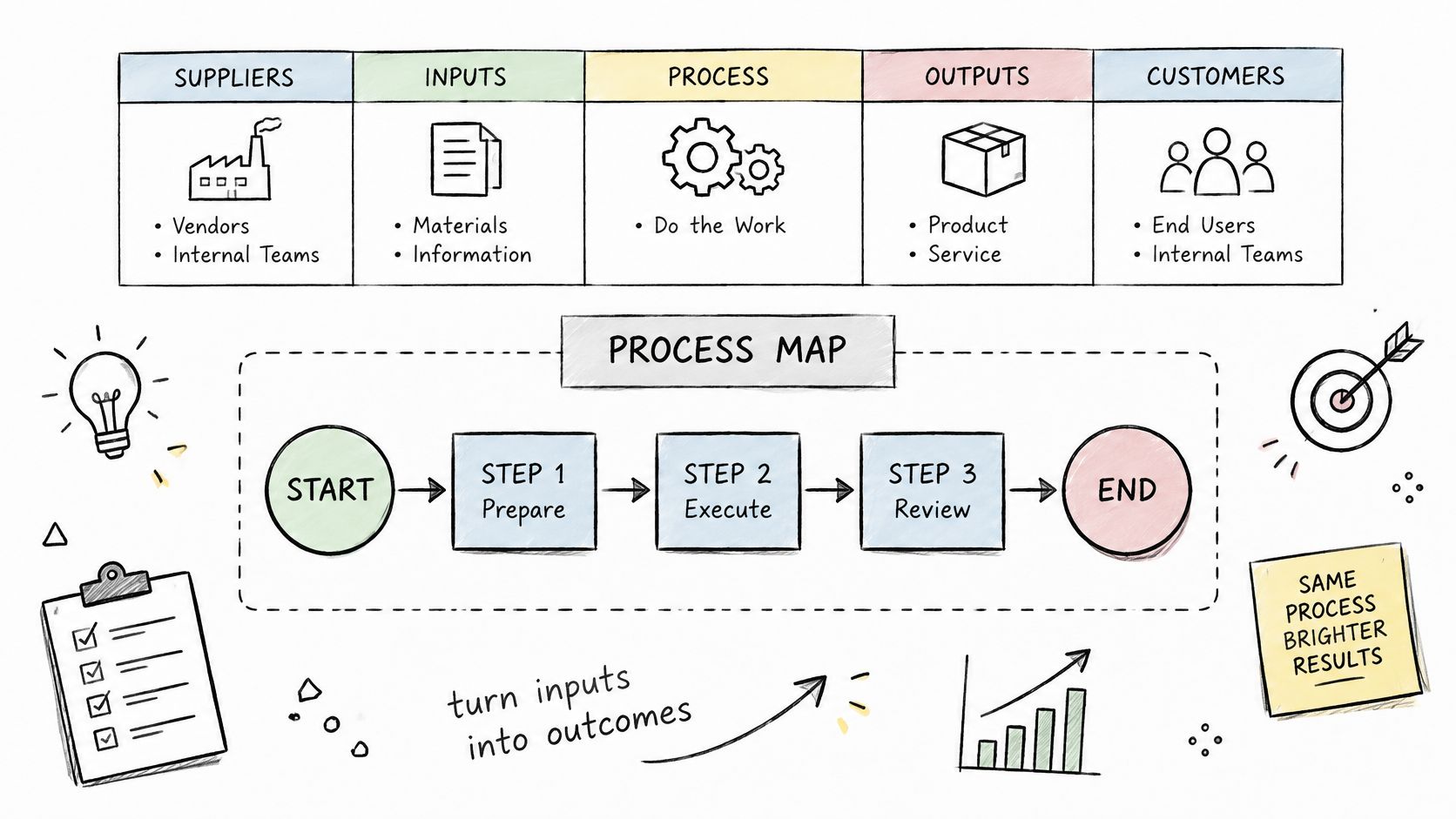
Define what belongs inside the map
In a hypothetical payroll services firm, the first map might cover employee record change to corrected payslip, rather than the whole payroll cycle. The payroll operations owner can then investigate missing evidence, approval delays and correction failures without mapping unrelated billing work.
The scope record should contain:
- Decision required: Whether to repair the correction workflow or replace its supporting software.
- Start and finish: An accepted employee change request through to a corrected payslip and confirmed record update.
- Accountable owner: The payroll operations lead, with authority to resolve disputed process rules.
- Deliberate exclusions: Payroll funding, customer invoicing and unrelated employee changes.
For legacy system migration services, the boundary should also identify integrations that must keep working during the transition. A narrow map isn't incomplete when its exclusions are explicit. It's focused enough to support a decision.
2. Use BPMN 2.0 as a shared notation
Put a decision gateway in the overview when its branches lead to different owners or actions. Business Process Model and Notation (BPMN) gives finance, operations and engineering a shared way to represent tasks, events, decisions and flows.
The Object Management Group's BPMN specification defines elements for modelling processes, including tasks, gateways, and start, intermediate and end events. Use them to show what triggers work, where a decision occurs, and which activities happen in parallel.
Keep the model readable. Start with the smallest agreed set of symbols that describes the workflow, then add detail where a branch changes ownership, approval or the record being updated.
Separate the overview from implementation detail
For a healthcare coordination platform serving managed-service businesses (MSPs), the overview could show a request moving through matching, acceptance, fulfilment and closure. Separate participants for the client, worker and platform make their messages and handoffs visible.
Keep matching details in a linked subprocess. Show availability checks, rejection paths and timeouts there, along with the record updated after acceptance. This keeps the overview useful without hiding the operational steps.
Use a short modelling convention:
- Legend: Define the events, tasks, gateways, participants and message flows in use.
- Labels: Name tasks with verbs, such as “verify availability,” and gateways with conditions.
- Linked detail: Put complex subprocesses in separate diagrams and link them to the overview.
Keep the editable source with the relevant documentation or code. A screenshot helps readers, but it cannot support the next person who needs to revise the model. Test whether tools preserve the diagram's meaning when importing or exporting it; a diagram that looks right may not behave as intended when treated as executable software.
3. Map and validate how the process actually runs
Finance depends on a customer reference field that the support application marks as optional. Support staff enter it manually so finance can reconcile credits. A policy document would miss that dependency; case records and operator walkthroughs reveal it.
Compare the intended process with recorded execution. Conformance checking uses process-mining methods to compare event records with a predefined model, as described in this process-mining study. The comparison is useful only when the records capture the events that matter.
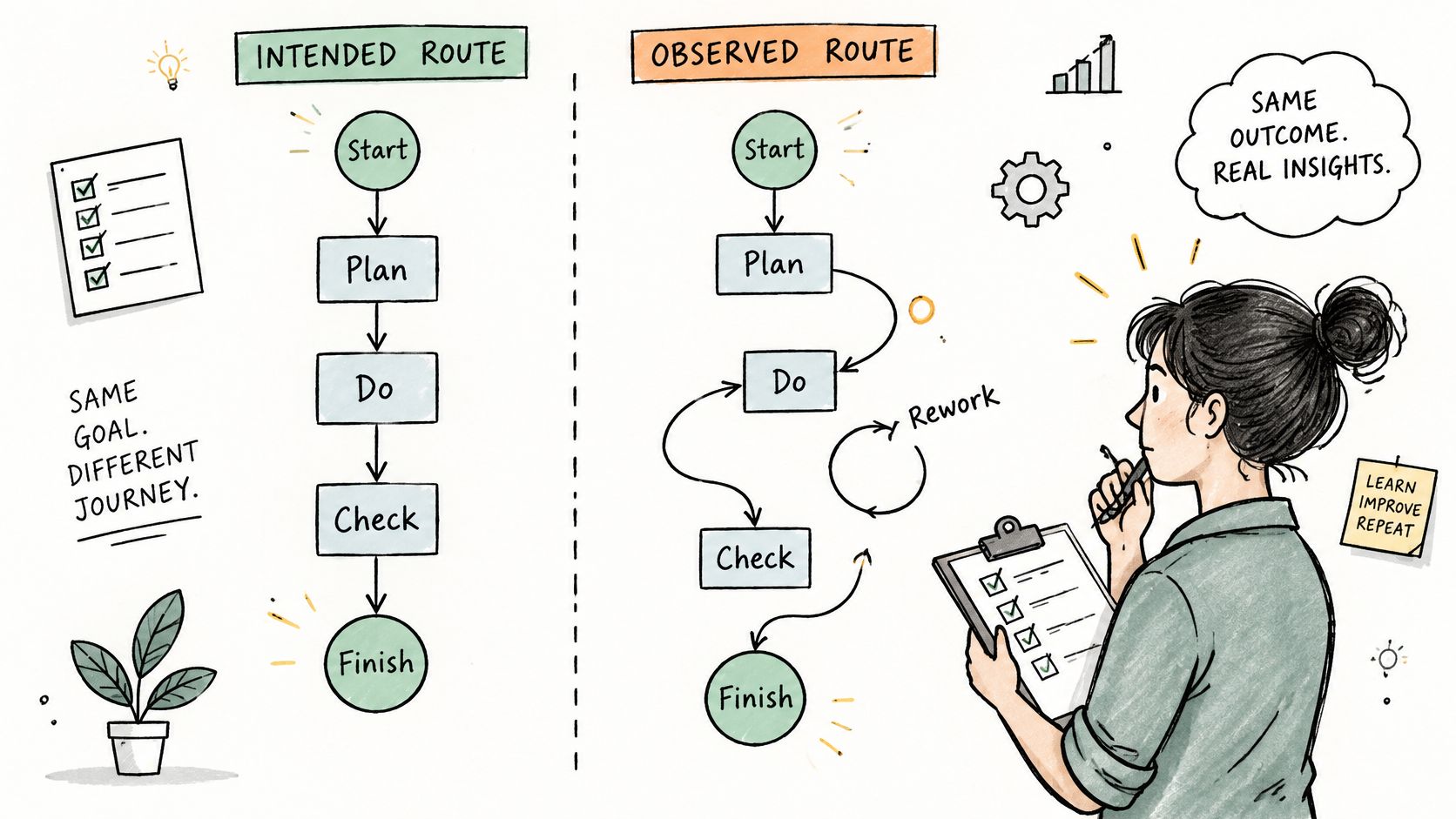
Walk real cases through the draft
Use the customer reference field as a test case. Trace completed work, reopened tickets and unusual exceptions through the draft map. Check whether the map shows where the field is entered, who relies on it and which record stores it.
Combine observation with operational records:
- Follow recent cases: Include completed work, reopened tickets and unusual exceptions.
- Ask adjacent owners: Confirm that each handoff gives the receiving team the information it needs.
- Record disagreements: Name who describes a different route and identify the case that supports each account.
- Capture elapsed time: Separate active work from waiting for a response.
Process mining can strengthen validation when logs include case identifiers, activity names, timestamps and outcomes. It cannot reveal a telephone approval that nobody recorded. For workflows involving several objects, such as a customer, application and document, check whether they follow distinct paths before assigning them a single case identifier. Combining separate paths can distort the analysis.
The process owner approves the reconciled current-state map and sets its next review trigger. Assess each workaround against its purpose and impact before deciding whether to retain or change it.
4. Use swimlanes to make ownership and handoffs visible
The screening check completes, but the employer never receives a usable decision packet. A swimlane map can show where that handoff fails by assigning each activity to the role or system responsible and identifying what crosses between them.
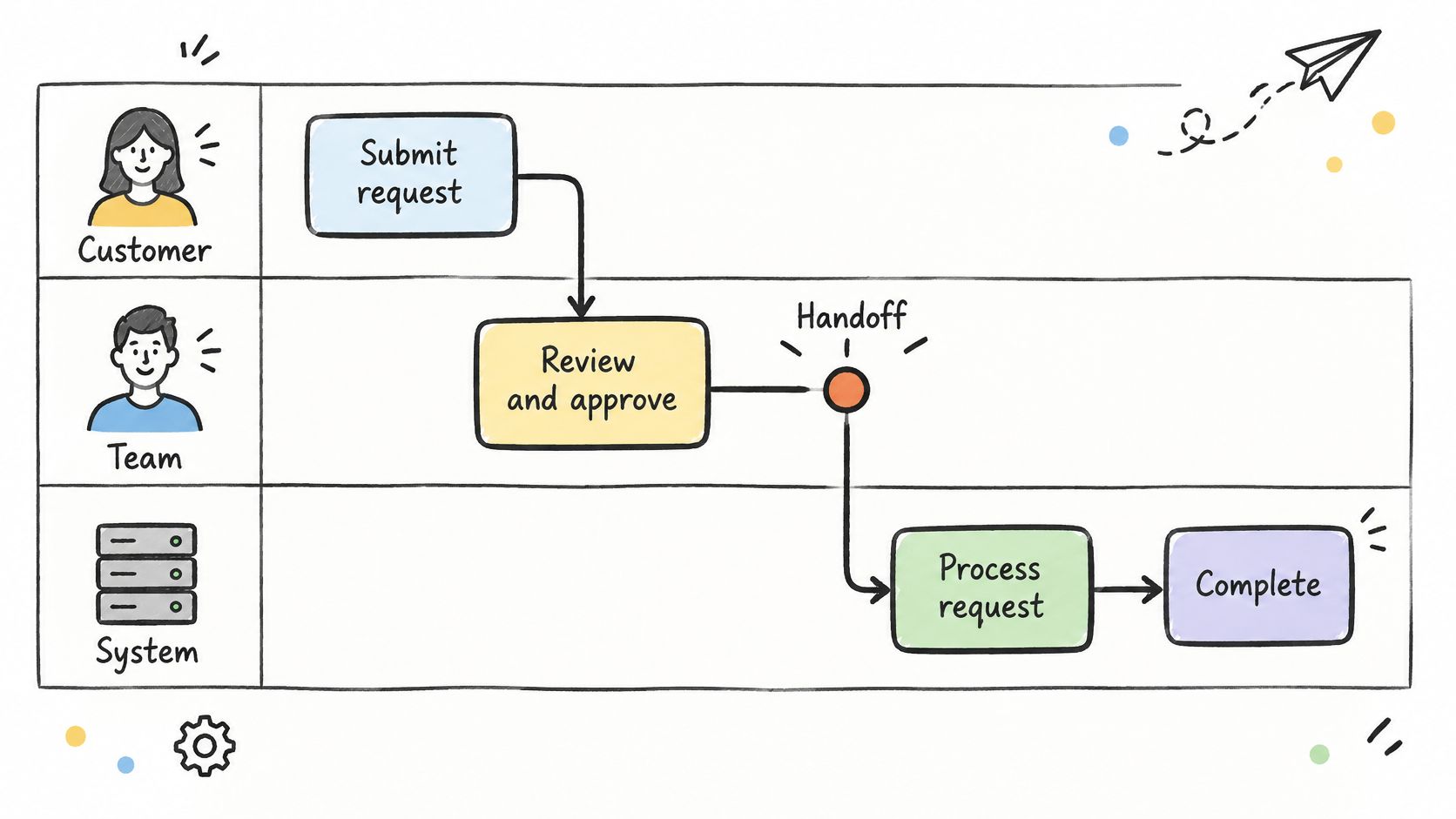
The ISO guidance on the process approach connects activities with their inputs, outputs, responsibilities, risks and controls. Swimlanes make responsibility visible; handoff details explain what the receiving owner must do.
Describe the transfer, not just the arrow
Name lanes for operational roles where possible. “Screening reviewer” gives the team a clearer assignment than “operations.”
For each crossing, record:
- Sending owner: Who prepares and sends the handoff.
- Receiving owner: Who accepts it, rejects it or requests more information.
- Required record: The evidence packet, status update or instruction being transferred.
- Acceptance condition: What makes the transfer complete and what happens when information is missing.
Count the handoffs before proposing automation. A delayed transfer may need a clear acceptance rule, not another integration.
For automated work, show where the agent prepares a recommendation and where a person authorises a consequential action. The agentic software development life cycle also depends on keeping execution, review and release approval distinct, with an owner for each step.
A role label is only useful when the assigned owner has the access, capacity and permission to act. Confirm those conditions during validation, then carry them into the handover so the map guides real work.
5. Record decisions, exceptions, and the rules behind them
A payment reaches finance with complete evidence and meets policy. The approver sees why it qualified, while a request missing documents returns to its owner. A useful map shows these routes and records the rule behind each decision.
The Object Management Group's BPMN guidance describes gateways as points where process flows diverge or converge. Use a gateway for a decision that selects a route. Show parallel work separately, and use events for messages, timers or failures that change what happens next.
A human-review box isn't an approval control unless the reviewer can see the evidence, reject the recommendation and stop the action.
Keep a decision record beside the gateway
Link each gateway to a rule record that identifies:
- Inputs and provenance: The fields used in the decision and the system that supplied each one.
- Authority: The role allowed to approve, reject, override or escalate.
- Fallback: The route when evidence is missing, a system fails or confidence is insufficient.
- Change history: The date, reason and approver for each rule change.
A study of automated decision-making experts identifies weak oversight, poor data provenance and unclear accountability as risks. Map who makes each judgement and what evidence they use. A review step added after automation does not establish meaningful oversight on its own.
Automate frequent exceptions only once their rules are stable. Rare exceptions still need a defined destination and an owner with authority to act. Record the reason for each route so reviewers can distinguish an approved exception from a case the process failed to handle.
6. Layer the customer journey over the internal process
A customer sees “approved” in an email, but the account still shows “pending.” The back-office task may be complete; the customer's next step is still unclear. Map that visible moment alongside the internal process so the team can see which backstage action must happen before each customer-facing response.
Connect each customer moment to a backstage owner
Consider a supplier onboarding process. A vendor submits details, receives a request for missing documentation, and later asks why approval is still pending. The customer layer should connect each moment to the internal record, the team responsible for the next action, and the status message the vendor receives.
For each moment, record:
- Customer action: What the customer submits, accepts, changes or disputes.
- Visible response: The confirmation, status or explanation they receive.
- Backstage dependency: The record or approval needed to make that response accurate.
- Recovery owner: The role responsible when the promised response doesn't arrive.
Keep the layer focused. Mapping every message can make the operating map difficult to maintain. Include moments when the customer must act, wait for an outcome or needs help recovering from a missed or delayed response.
The map can show what the process promises, not how a customer feels. Use customer feedback or usability testing to check interpretations, and label assumptions clearly. That distinction helps the team avoid redesigning a process around a frustration customers have not reported.
7. Measure time, cost, and rework on the map, not just the sequence
Finance staff finish the invoice comparison quickly, but invoices wait for purchase-order evidence. The map should show where cases spend time and where work repeats, so the process owner can decide which delay to address first.
Deloitte's Global Process Mining Survey found that 51% of organisations were actively using process mining. Connect the diagram to execution records where they are available; interviews alone may miss how long cases wait or how often they leave the standard route.
Separate handling effort from elapsed time
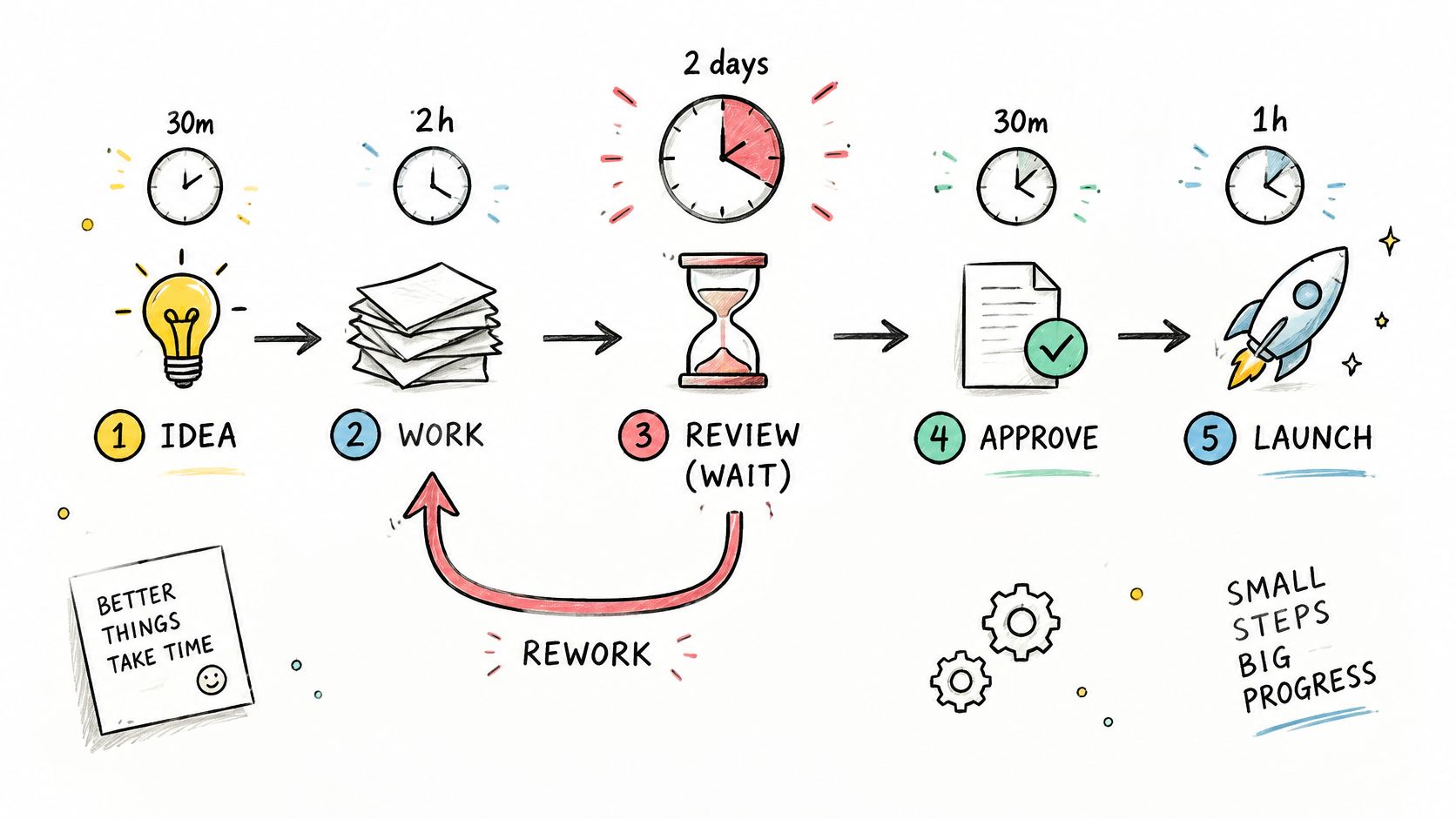
Automating the comparison step may reduce finance staff's handling time while leaving the wait for purchase-order evidence unchanged. Measure both to avoid prioritising the wrong fix.
- Cycle time: Elapsed time from the agreed trigger to the completed outcome.
- Processing and waiting: Active handling time, queue time and time awaiting information.
- Rework and exceptions: Cases that repeat a step or leave the standard route.
- Volume and cost: Case counts and attributable handling costs, with the calculation method recorded.
When complete logs are unavailable, sample recent records to establish a provisional baseline. Include unusual cases and state what the sample covers.
Evidence discipline: Mark every figure as measured, estimated or assumed. A precise-looking estimate is still an estimate.
Show the median and range where possible. An average can conceal long-running cases. Use the same start event, end event and case population when comparing results after a change.
The process owner should establish whether released capacity changes staffing needs, throughput or service quality before claiming a financial saving. Faster processing alone does not prove lower costs.
8. Keep the map as a living handover artefact with a named owner
The process owner approves operational changes, and the technical owner checks that implementation matches the approved process. Name who updates the map and where the current version lives.
A 2023 study by the Business Process Management Study reported that 95% of surveyed companies modelled their processes, while 55% used a systematic approach to collecting process maps. A map stays useful only when someone maintains its connection to operational decisions and changes.
Make the next team able to explain the workflow
For example, a fintech team could keep its approvals map alongside the rule configuration. A change request would link the updated gateway to the business approval, tests, and deployment record. The next reviewer could then see what changed and why.
A useful handover record includes:
- Ownership and version: The accountable process owner, technical contact, and current revision.
- Supporting evidence: Validated cases, measurement definitions, and known data gaps.
- Design rationale: Why the team retained an approval, rejected an alternative, or accepted a limitation.
- Review triggers: Releases, policy changes, integration changes, and recurring exceptions that require reassessment.
This record also supports application management services, where operating knowledge must remain usable as software and responsibilities change. When another team needs to repeat the process, Franchise Foundry on scaling documentation explores why a clear operating reference matters beyond the original author's memory.
Grail Computer Labs advises documenting the control pattern before another team copies an adjacent workflow. For AI workflows, connect directly to the system of record and preserve enough context for the next reviewer to understand why the agent acted.
A maintained map makes handover questions traceable and answerable without reconstructing decisions from chat history.
How each mapping practice fits into a process improvement project
Choose the first mapping practice based on the decision the team needs to make. The artefact should help the process owner settle that decision, then give the next owner a usable starting point.
| Situation | Apply this practice first | First artefact to produce |
|---|---|---|
| The team cannot agree on what is in scope | Start with a specific question and a clear process boundary | A boundary statement naming the trigger, endpoint, owner and decision to support |
| Business and technical teams interpret diagrams differently | Use BPMN 2.0 as a shared notation | A small notation key with the symbols used in the process diagram |
| The documented flow conflicts with staff accounts or system records | Map and validate how the process actually runs | A current-state map annotated with observed variants and unresolved questions |
| Work waits between roles, teams or systems | Use swimlanes to make ownership and handoffs visible | A handoff list naming the sender, receiver, transferred information and next action |
| Staff cannot explain why cases take different routes | Record decisions, exceptions and the rules behind them | A decision table listing conditions, outcomes, rule owners and exception routes |
| Internal completion does not match the customer's experience | Layer the customer journey over the internal process | A service blueprint connecting customer actions with internal activities |
| The team knows a process is slow but cannot locate the loss | Measure time, cost and rework on the map, not just the sequence | A measurement sheet defining the start and stop points, units and rework count |
| Several teams use different versions of the process | Keep the map as a living handover artefact with a named owner | A version-controlled map with a named maintainer and review trigger |
These artefacts should answer a practical question, not create another layer of documentation. If a handoff list exposes an unowned transfer, for example, the process owner can assign responsibility before the team redraws the entire workflow. If records disagree, mark the uncertainty on the map and resolve it before treating the diagram as a baseline.
Use BPMN 2.0 where teams need a consistent diagram, but keep the notation key small enough for operators to use. A precise diagram that the people doing the work cannot read will not support validation or change. Likewise, timing data is useful only when the team defines what counts as elapsed time, rework and completion.
Turn the Map Into a Decision, Then Act on It
A useful map changes a decision. The operations owner can identify which handoff needs repair. The engineering lead can separate a missing business rule from an implementation defect. The approval owner can explain which actions may proceed automatically and which require judgement.
The starting point should be a workflow with a visible problem and an owner who can authorise change. A broad enterprise catalogue may eventually be valuable, but it shouldn't delay investigation of a specific failure. For founders, chief technology officers and leaders of private equity (PE)-backed companies, the immediate question is often whether the existing workflow can be repaired or needs rebuilding.
Move from evidence to a controlled change
The owner should select an intervention supported by the map and records. If cases wait for missing documents, improve the intake and rejection route before accelerating downstream processing. If operators bypass an approval, establish whether the policy is impractical, the software is broken or the approval authority is unclear.
A useful change record should state:
- The hypothesis: Which change is expected to improve which operational outcome.
- The control boundary: Which decisions remain with people and when automation must stop.
- The comparison: Which baseline, case population and measurement definitions will be retained.
- The recovery route: Who responds if the change fails or creates unexpected exceptions.
The map is evidence about the workflow, not proof that a proposed intervention will work. Deployment tests, operational monitoring and a post-change review still matter. Where records are incomplete, the owner should improve instrumentation rather than present assumptions as measured results.
Preserve the reasoning during delivery
GC Labs specialises in software rescue, replacing underperforming vendors and moving stalled artificial intelligence (AI) and software projects towards production. Its outcome engagement defines one measurable outcome for delivery in 4–8 weeks. Continuous delivery means the same team keeps delivering afterwards, like an in-house tech team.
GC Labs' Software Factory is its AI software factory: agents execute, GC Labs engineers make the decisions, and customers see progress. The operating map should remain connected to implementation, tests and release decisions throughout that work. Otherwise, delivery can recreate the same knowledge gap that made the inherited platform difficult to change.
A workflow discussion can happen before a delivery commitment. Qualified clients can also start an outcome engagement with a 15-day trial, with the option to stop within the first 15 days without paying.
Grail Computer Labs offers software rescue, custom AI models, internal operations automation and legacy re-platforming, with process ownership and approval boundaries made explicit. Visit Grail Computer Labs to book a call about a mapped workflow, its unresolved decisions and the measurable outcome a delivery engagement should address.