
Creating AI Models: A Step-by-Step Guide for 2026
A practical guide to creating AI models: define the use case, prepare data, train, evaluate and deploy responsibly, step by step.

The popular advice on creating AI models starts too late: choose an architecture, collect some data and start training. That sequence can produce a convincing demonstration without establishing who can use it, which mistakes matter or what happens when it fails.
A stronger starting point is a production contract. The business decision, error costs, operational owner and rollback conditions belong in writing before any training run. For founders and engineering leaders, that changes the investment question from whether a model can work to whether the organisation can operate it safely and measure its value.
The Build Sequence at a Glance
Creating AI models involves a sequence of business and engineering decisions, not just a training pipeline. Each stage needs an owner with authority to accept its output, reject it or send the work back.
The sequence below separates technical progress from permission to launch. A completed training run isn't a release decision, and a successful evaluation doesn't establish that the surrounding workflow is ready.
| Stage | Question it answers | Main output | Owner |
|---|---|---|---|
| 1. Define the decision | Which decision does the model change? | One-page use-case brief | Business owner |
| 2. Set the production contract | What error costs and limits are acceptable? | Error budget, latency and cost limits | Business owner with engineering lead |
| 3. Collect and audit data | Is the data representative of live use? | Versioned dataset and audit report | Data lead |
| 4. Train and evaluate | Does the model beat a simple baseline on untouched data? | Evaluation report with uncertainty | Machine learning engineer |
| 5. Shadow deploy | Does it hold up on fresh live data? | Shadow results and go or no-go decision | Engineering lead |
| 6. Monitor and retrain | Is it still performing as intended? | Monitoring dashboard and retrain triggers | Operations owner |
Treat failed gates as useful information
The loop isn't one-way. A failed evaluation may require better labels, a narrower population or a different outcome definition rather than another architecture. Engineering leaders should resist treating every failure as a reason to increase training spend.
Consider a hypothetical regional lender that wants to pre-sort loan applications. Before anyone opens a notebook, the lending operations owner accepts the error budget, identifies the human review point and confirms that sorting won't itself approve or reject an applicant.
Skipping that agreement creates avoidable delays later. Teams can otherwise discover that a technically acceptable error rate is commercially unacceptable, or that nobody has authority to act on the output.
Readiness check: The business sponsor should be able to name the decision the model changes, the person who owns it and the measurement that would make the team stop.
If any answer is missing, training isn't the next useful action. Clarifying the operating decision is.
How to Define the Use Case and Production Contract
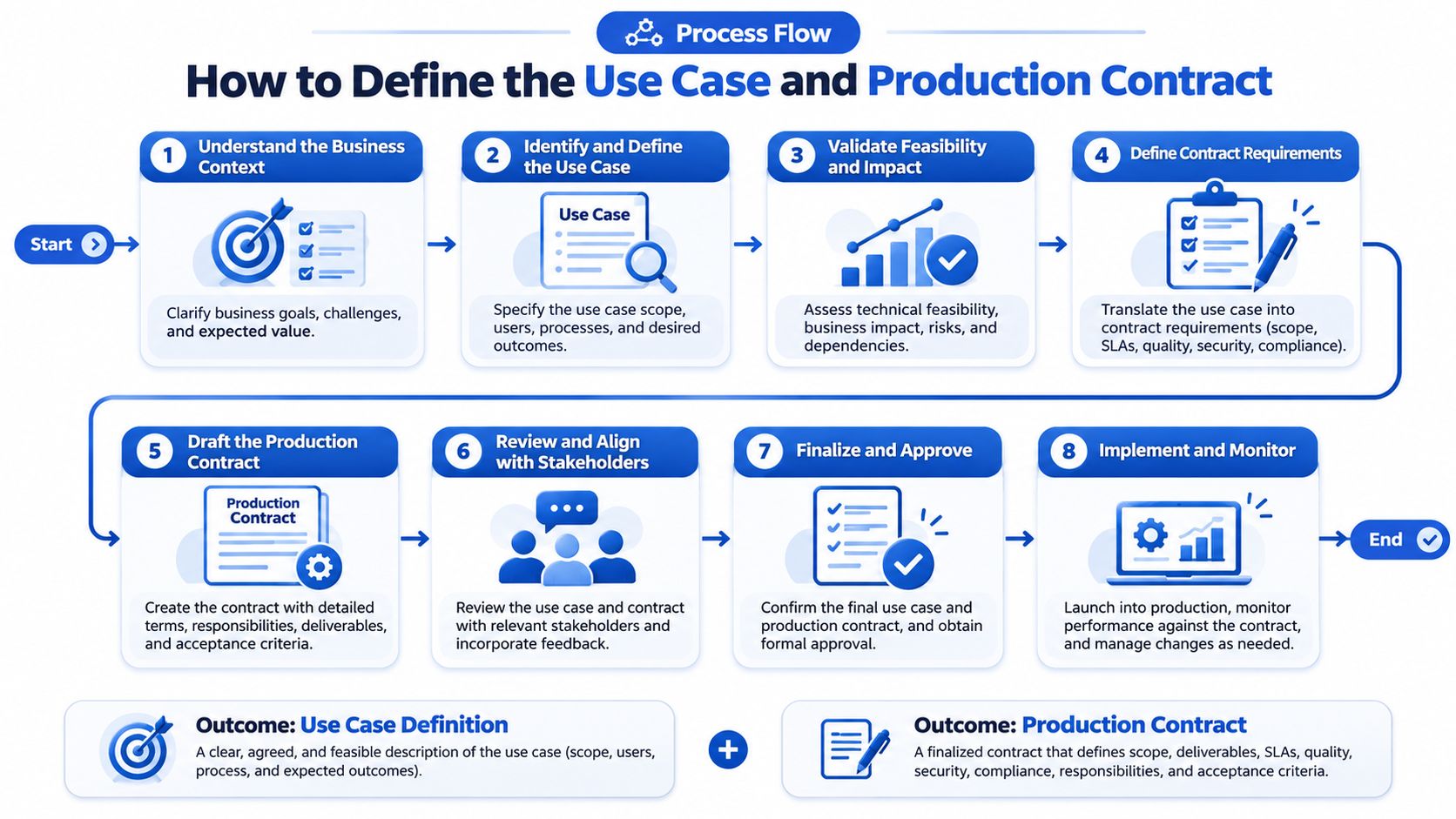
A model creation project should begin with a production contract. The decision, error costs, owner, approval path and rollback trigger are fixed before training, so evaluation measures an operating claim instead of a general model score. That discipline matters because a strong first workflow has high repetition, clear evidence sources, visible owners and obvious approval points. Grail Computer Labs recommends those characteristics because they create a short feedback loop and make value easier to establish without trusting a black box.
Describe actual behaviour: which claims enter the approval path, which need investigation and who handles exceptions. “Improving efficiency” is too vague to test. A claims workflow needs names, routes and limits that an operations owner can accept before build work starts.
Write the operating rules before training
Name the decision in a sentence. For a hypothetical insurer, the model recommends whether an incoming claim follows routine processing or specialist review. It does not decide every aspect of the claim.
Describe users and operating conditions. Record which claims system supplies inputs, when submissions arrive, which documents are available and what the handler sees. A model evaluated on complete files has not established performance on partially submitted claims.
Set error limits and consequences. A wrongly cleared claim may expose the insurer to an inappropriate payment. A wrongly flagged claim adds review work and delays the customer. The claims owner must accept separate limits for these errors rather than approve an aggregate accuracy score.
Agree latency and cost per decision. The engineering lead should express these as measurable limits under expected demand. A result that arrives after the handler has finished the task has little operational value.
Mark approval boundaries. Specify the actions the system may stage, the actions an authorised handler must approve and the decisions that remain fully human. Missing evidence should trigger an explicit review route, rather than an improvised default.
Name the operational owner and rollback threshold. Record who receives alerts, who can suspend automation and which breach requires that action. Ownership must survive the departure of the build team.
The contract also needs a plain-language explanation. Before expanding an AI workflow, the owner must be able to explain the workflow in plain language, the exception queue must be small enough to review and well categorised, and the approval boundary must be explicit and accepted by real business stakeholders. If those conditions are absent, more model accuracy will not settle who owns the decision.
Make validation specific to intended use
The NIST AI Risk Management Framework distinguishes validation, objective evidence that requirements for an intended use are met, from reliability, performing as required without failure over a period under stated conditions. Both require written criteria and ongoing assessment, rather than a favourable offline result.
In the hypothetical claims workflow, a complete, eligible claim can enter the routine approval path after the required human sign-off. Missing documents, contradictory evidence or a score below the owner-approved confidence threshold send it to review. If audited wrongful clearances exceed the contract's limit, the system stops routing claims automatically.
Calibration gives the threshold meaning. Confidence scores need comparison against observed errors because a confident-looking output gives no evidence that the system knows when it is wrong. For clinical work, Grail uses the least expensive AI model that passes every clinical test, and records the model used, response time and token count so every result can be traced to the setup that produced it. A replacement model first runs beside the current one without changing the doctor's record, and takes over only after performing better on the same consultations.
The final acceptance test is organisational. The operational owner should be able to explain the workflow, exceptions and approval boundary in plain language without the data team in the room.
How to Collect and Audit Training Data
A dataset can be internally tidy and still represent the wrong problem. Training a support-ticket classifier on a clean archive won't establish how it handles incomplete messages, unfamiliar products or requests arriving through a different channel.
In a hypothetical support operation, most labelled tickets come from a flagship product. The classifier performs well overall but routes other product enquiries incorrectly. Meanwhile, one team uses urgent for service outages and another uses it for commercially important customers, so the target label doesn't have a stable meaning.
Start with live channels and explicit labels
The data lead should sample the channels the model will receive, including awkward cases. Preserve the input as it existed at decision time, rather than adding information that became available after resolution.
Written labelling instructions should define each class, exclusions and ambiguous cases. Having independent reviewers label a shared subset exposes disagreements before those disagreements become training targets. BUNCH's guide to scaling training data with BUNCH offers useful context for organising that annotation process.
The audit should follow a practical order:
- Accuracy: Check source records against the underlying event or document. Incorrect source values won't become reliable through training.
- Completeness: Identify missing fields and documents, including whether missingness differs by channel.
- Consistency: Check units, categories and meanings across contributing teams.
- Timeliness: Confirm that examples reflect the operating process and information available at the intended decision point.
- Class balance: Inspect rare but consequential outcomes rather than relying on the dominant class.
- Label quality: Review disagreements, unresolved cases and labels inferred from weak proxies.
Preserve provenance and expose leakage
Features that contain the answer can make a weak system look strong. A ticket's final resolution code, for example, mustn't appear among inputs used to predict its initial routing. Split related records together so versions of the same case don't land on opposite sides of evaluation.
Operational guidance in the KDnuggets deployment survey highlights weak labels, imbalance, upstream changes and training-serving skew as delivery risks. Before changing architecture, the team should test whether correcting these defects addresses the failure.
Each dataset version needs a short manifest:
- Provenance: Source systems, extraction date range and access permissions.
- Selection: Filters, exclusions and deduplication rules.
- Interpretation: Labelling instructions, review decisions and known gaps.
The gate is whether the dataset represents the intended population well enough to support a credible evaluation. If a material channel or customer group is absent, fix that gap or narrow the proposed deployment before training.
Costs, Ownership and Regulation to Check Early
| Model | Released | Estimated training cost |
|---|---|---|
| Original Transformer | 2017 | about $670 |
| RoBERTa Large | 2019 | about $160,000 |
| GPT-4 | 2023 | about $79 million |
Reference training costs from Stanford's AI Index show the gap between frontier research models and a narrow production model. The same source reports that training compute for notable models has approximately doubled every five months, while datasets for large language models have doubled roughly every eight months. Treat those figures as scale markers, not as a budget line for a focused workflow.
The useful conclusion is that the business case should cover the narrowest useful task and the entire operating lifecycle. That contract fixes the decision, the acceptable error cost, the owner, and the rollback path before training begins. Most tutorials start with the model and leave those questions until after the demo works. In production, that order creates avoidable rework.
Compare complete delivery paths
Enterprise AI efforts fail for many reasons, including weak ownership, unclear value measures, and a demo that never becomes an operating workflow. Treat the objective as measurable operating value, not a successful prototype. Grail's guidance is to evaluate AI workflow tools against one real workflow, one real owner, one real approval path, and one measurable business outcome.
Budget explicitly for data preparation, evaluation, infrastructure, inference, monitoring, security and migration. The options distribute those costs differently:
- An application programming interface (API): Reduces direct model operations, but requires scrutiny of data handling, usage costs, availability and exit arrangements.
- A fine-tuned open model: Offers adaptation and hosting control, with responsibility for licences, serving infrastructure and updates.
- A smaller private model: Suits a narrow task when privacy or predictable operation matters, but creates ongoing training and maintenance obligations.
A retrieval system may be enough when the core problem is finding current evidence. A rules layer may be better when policy is explicit and exceptions are manageable. The application management services guide provides context for budgeting ownership after release.
Ownership needs to be written down with the same care as architecture. The handover specification should identify who holds the weights, training data, prompts, evaluation sets, infrastructure configuration and decision history. Access to a prediction endpoint isn't equivalent to owning a maintainable system.
For clinical work, Grail uses the least expensive AI model that passes every clinical test and records the model used, response time and token count so every result can be traced to the setup that produced it. If a replacement model is proposed, it first runs beside the current one without changing the doctor's record. It takes over only after performing better on the same consultations.
Establish ownership and legal classification
Regulation changes the production contract because it changes evidence, documentation and control requirements. The European Commission's implementation timetable lists general-purpose model obligations from 2 August 2025 and transparency and related enforcement from 2 August 2026. It also sets out future application dates for additional high-risk categories. Confirm the current official timetable before publication or before tying delivery dates to those obligations.
For high-risk systems, the European Commission's AI Act guidance includes risk assessment, high-quality datasets, activity logging, technical documentation, information for deployers, human oversight, resilience, cybersecurity, accuracy and a conformity assessment before market entry or service.
Legal classification belongs before architecture approval. The responsible legal and engineering owners should establish which obligations apply, because that decision changes the build specification. It also changes who signs off, what evidence must be retained, and whether the workflow can expand without redesigning its controls.
How to Train and Evaluate Without Fooling Yourself
Each check of the test set turns it into design feedback, so the final score is less independent than it looks. A team that changes prompts, thresholds, preprocessing or model choice after reading holdout failures has already spent part of that holdout. The score can still describe performance on those records. It no longer answers the production question: will this candidate work on fresh cases under the agreed decision path?
The academic guidance on machine learning evaluation recommends validation data, holdout testing, multiple evaluations and statistical comparisons before claiming that one model is better. A benchmark score is comparative evidence. It does not show that a business workflow will improve.
Treat the experiment as a production contract. The decision, acceptable error costs, owner, approval path and rollback position need to be fixed before a training run, because those choices decide what "better" means.
Protect the experiment
Start with candidate models and a simple baseline, such as deterministic routing rules or the current manual process. Define the outcome before examining predictors, and include the important variables needed to interpret performance. Keep the deployment population and decision fixed across candidates.
Use the following sequence:
- Train on the training partition. Keep the deployment population and decision fixed across candidates.
- Tune against validation data only. Hyperparameters, prompts and decision thresholds are all design choices.
- Lock the pipeline. Freeze preprocessing, model versions, configuration and scoring code before final evaluation.
- Evaluate on the untouched holdout. Don't inspect failures, modify the candidate and then present its revised score on the same records as independent evidence.
- Execute the predeclared uncertainty analysis. Evaluate prespecified seeds or resample holdout predictions, reporting means and confidence intervals without using those results for further tuning.
Repeating a locked statistical analysis is different from redesigning the system against test results. If the team changes the pipeline after inspecting the holdout, it needs fresh independent evidence. That may mean a new holdout draw, a later time window or a shadow run, depending on how the workflow receives new cases.
For an engineering implementation reference, Beam's guide to fine-tuning Llama 3 on GPUs describes the mechanics. A completed fine-tuning run still hasn't proven that adaptation improves the intended decision. Training changes the model. Evaluation decides whether that change earns a place in the workflow.
Require a complete release gate
| Release check | What it tests | Evidence to record |
|---|---|---|
| Task metric | Accuracy, precision or recall against the supported decision | Mean and confidence interval across seeds |
| Calibration | Whether predicted probabilities match observed outcomes | Calibration curve on the test set |
| Subgroup performance | Whether errors fall unevenly on customer, region or product groups | Metrics per group with sample sizes |
| Stability under missing or shifted inputs | Behaviour with missing or shifted inputs | Results on perturbed and incomplete samples |
| Latency | Response time under expected load | 95th-percentile response time against the agreed limit |
| Cost per inference | Running cost at expected volume | Model, response time and token or call count against the cost limit |
| Rollback threshold | The point at which the model is switched off | Written threshold agreed before shadow deployment |
Each row should map to a decision the business owner already accepts. A subgroup result matters when a region, customer type or product group faces a different error cost. A latency result matters when the workflow has a response limit. A cost result matters when the candidate uses more model capability than the outcome requires.
Grail Computer Labs uses the least expensive AI model that passes every clinical test and records the model used, response time and token count so every result can be traced to the setup that produced it. The same selection discipline applies elsewhere. A stronger candidate earns its place by passing the full gate, not by sounding more capable.
For clinical copilots, model replacement follows a specific rule: a replacement first runs beside the current model without changing the doctor's record, and takes over only after performing better on the same consultations.
Reproducible evidence should sit inside the agentic software development lifecycle, rather than in a disconnected notebook. The evaluation record needs to connect the dataset, pipeline versions, decision threshold, owner, approval path and rollback condition to one candidate. That is what makes the result usable after the experiment ends.
MLPerf Training measures wall-clock time to reach a specified quality metric on a specified dataset. Internally, fix the dataset, metric and acceptance threshold before comparing architectures, hardware or adaptation strategies.
A candidate counts as better only when its improvement over the baseline on untouched data is large enough for the confidence interval to support the claim.
How to Deploy in Shadow Mode and Monitor It
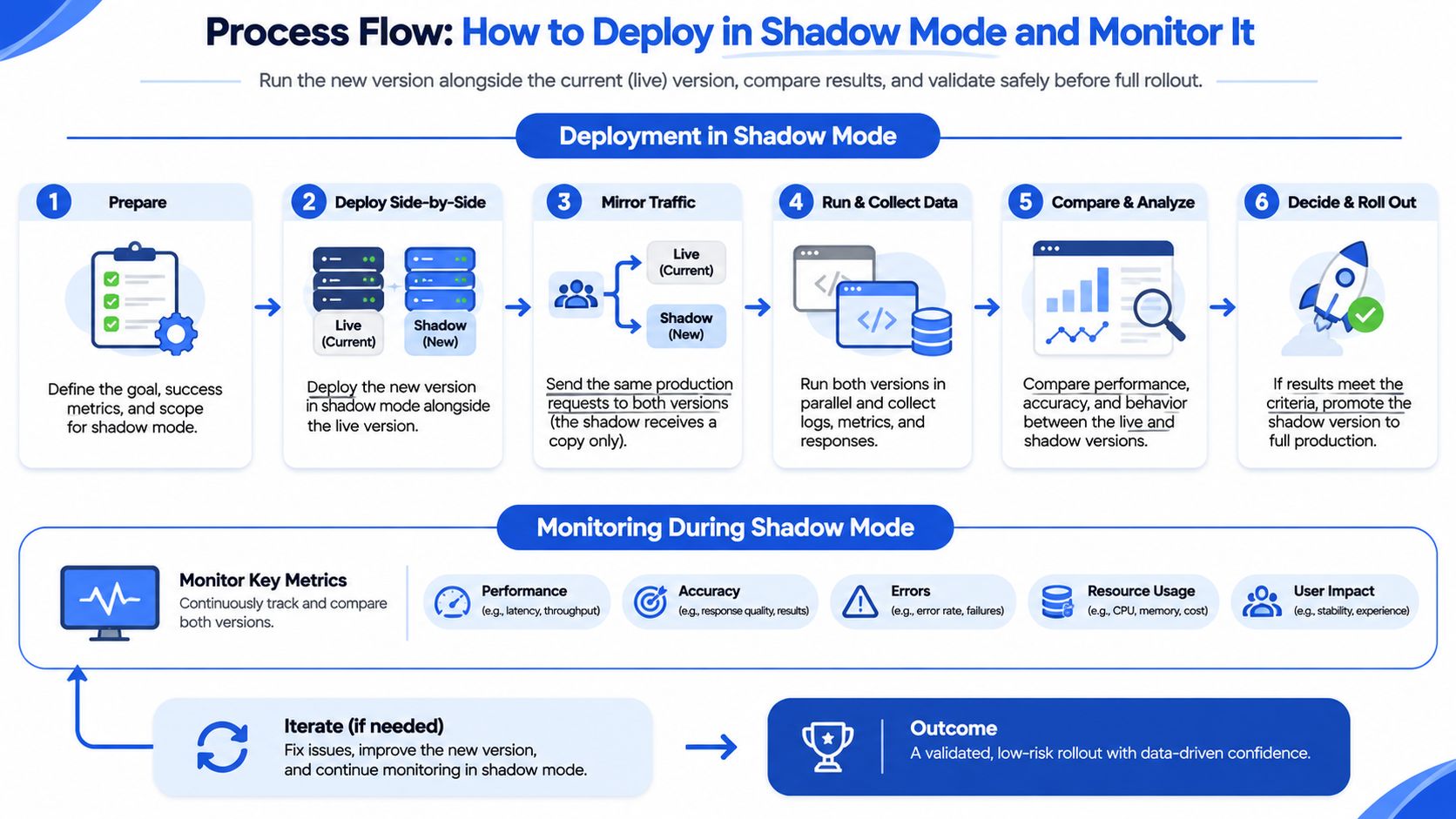
Shadow deployment gives engineers production inputs while the current workflow keeps decision authority. The candidate sees fresh live cases, and the existing process remains responsible for records, notifications, approvals and customer-facing actions.
That separation matters in multi-party service environments. A wrong routing decision can affect clients, workers and partners. Technical access to production is not the same as permission to change the workflow.
Give authority gradually
Package the complete system. Version the model alongside preprocessing code, dependencies and configuration. A difference in input handling can invalidate an offline result before the model receives its first live case.
Run beside the current process. Send fresh inputs to the candidate without allowing its output to update records, notify customers or authorise actions. This produces matched evidence without moving operational control.
Compare matched cases. Inspect differences against both the current process and holdout expectations. Include delayed outcomes when correctness cannot be established immediately, such as approvals that later reverse or tickets that reopen.
Bound human review. Route uncertain and high-stakes cases to named reviewers with clear categories and escalation rules. The exception queue must stay small enough to review and well categorised. An unbounded queue turns review into a hidden second workflow.
Promote only after sustained acceptance. The owner approves a pre-agreed observation period that covers relevant operating conditions, not just a quiet interval. The approval boundary must be explicit and accepted by real business stakeholders before live changes begin.
Monitor and retrain on evidence. Track quality, latency, data drift, abstention and cost. Retraining should address an observed problem, not satisfy an arbitrary calendar.
Keep the user-facing workflow stable
A replacement clinical copilot can run beside the current assistant while doctors continue using the same record. The replacement reads the same consultation inputs, proposes outputs and stays out of the doctor's record until matched-case results support a change and the operational owner accepts the evidence.
That is controlled replacement: the new model advises, and it gains live records only after it earns that change. The same discipline applies when systems are replaced as part of legacy system migration. Engineers watch for training-serving skew, silent upstream field changes and alerts that no longer have an owner.
The practical test is whether the candidate is ready for a wider remit. Explain the workflow in plain language, keep the exception queue reviewable and make the approval boundary explicit. Only then should the model move from observation to controlled authority.
When the rollback threshold is crossed, restore the previous version, log the event and investigate the data before starting another training run.
Confirm the Use Case Before You Commit Budget
Budget should follow a production decision, not interest in a model family. A narrow workflow with a named owner, a usable evidence trail and a specific outcome gives finance, operations and engineering something concrete to judge. A broad AI programme with vague acceptance criteria makes it easy to spend money before anyone can say what should change.
Make the budget decision explicit
- Workflow acceptance: One workflow, one owner, one approval path and one measurable outcome are written down.
- Data readiness: The audit covers live channels, or the missing coverage will be fixed before model spend.
- Delivery economics: The chosen API, fine-tuning or private-model path includes every lifecycle cost line.
If an item fails, narrow the task or stop. An inherited project may need recovered context, reproducible tests and clarified ownership before it needs a new model. The earlier production rules still apply: the workflow owner must accept the approval boundary, the exception queue must stay reviewable and well categorised, and the workflow must be explainable in plain language before it expands.
Distinguish delivery evidence from a promise
A delivery plan becomes credible when it names the thing being funded. That might be a set of automated workflows, a workflow takeover, a rebuilt component or a model path tied to one measurable operating result. Grail evaluates AI workflow tools against one real workflow, one real owner, one real approval path and one measurable business outcome. That keeps the discussion on operating fit rather than model novelty.
A promising pilot can still depend on people reviewing outputs. The useful question is whether that review is deliberate, bounded and accepted by the business. A clinical consultation copilot, for example, can use the least expensive model that passes every clinical test, with the model used, response time and token count recorded so each result can be traced back to the setup that produced it. A replacement model runs beside the current one without changing the doctor's record, and takes over only after performing better on the same consultations.
Testing evidence has a narrower job than production evidence. A testing improvement shows that a candidate can meet a defined bar under defined conditions. It does not prove sustained production quality, stable exception handling or business acceptance. Funding should therefore separate the cost of reaching the test from the cost of running the workflow after release, including monitoring, review, retraining and the operational owner's time.
The same discipline applies when the desired result starts to look like an AI employee. Grail defines an AI workflow as narrow, path-shaped and trigger-driven, while an AI employee is role-shaped, memory-bearing and has a broader operating remit. Start with two or three workflows that share an owner or domain. Collapse them into something broader only after those workflows work well and their approval paths are stable.
The closing decision is simple. Fund the next stage when the workflow, owner, evidence path and outcome are clear enough to operate. Hold funding when they are still descriptions. A model can be technically impressive and still be a bad buy if the business cannot explain where it acts, where people approve and how it will be replaced.
Grail Computer Labs offers custom AI model development and software rescue through an outcome engagement, with a 15-day trial for qualified clients and delivery through its Software Factory. Visit Grail Computer Labs to book a call about the decision, data and release gates, or discuss an outcome engagement for teams that need a production workflow they can run and hand over.