
Software Development Outsourcing: Models and Risks
Compare software development outsourcing models, spot the risks that stall projects, and keep code, delivery visibility and knowledge in your hands.
Eight out of ten businesses engaging overseas providers had experienced major problems, according to a 2007 Communications of the ACM analysis. That historical finding doesn't establish today's failure rate, but it challenges a persistent assumption: adding external developers doesn't automatically restore delivery. For a stalled product, the harder question is whether a new team can recover the knowledge, decisions and operating control needed to ship safely.
What Software Development Outsourcing Means and Why Buyers Use It
Software development outsourcing means contracting an external team to build, run or change software. The arrangement might cover a defined application, an evolving backlog or responsibility for an existing platform. The team might work in the same country, a neighbouring region or overseas.
Buyers usually start with a concrete constraint. A product has stopped moving, an internal team lacks specialist skills, or recruitment can't supply capacity when the business needs it. External delivery can address those constraints, but it doesn't remove the need for an accountable product owner inside the client organisation.
Capacity isn't the same as control
For founders and chief technology officers (CTOs), the critical distinction is between delegating implementation and abandoning decisions. Someone must still resolve competing priorities, explain business rules and accept the result. A contract can assign responsibilities, but it can't supply missing operational knowledge.
That matters for enterprises, private equity (PE)-backed companies and managed-service businesses (MSPs), meaning non-IT service firms running a multi-party platform. Their software often connects customers, workers and partners. A misunderstood exception can disrupt a live service even when the code matches the written specification.
Practical rule: Delegate delivery only when decision ownership and access to delivery evidence remain clear.
Keeping work external isn't necessarily a permanent decision. In the 2024 Deloitte global survey, 70% of executives said their organisations had selectively brought work back in-house from a third party during the previous five years.
That finding covers third-party work broadly, not just software. It nevertheless makes reversibility a sensible buying criterion. The decision is to choose the model for the work, then establish the controls before signing.
Software Development Outsourcing Models Compared
| Model | Who carries delivery risk | Best fit | Main risk to watch |
|---|---|---|---|
| Fixed-price project | Provider, if scope is fully defined | Stable, well-documented requirements | Each change request reopens the price |
| Time and materials | Client | Discovery or unclear scope | Cost drifts without milestones |
| Dedicated team | Shared | Long-running product work | Knowledge stays with the team unless documented |
| Managed pod under continuous delivery | Shared, with one accountable team | Products that must keep shipping after go-live | Dependence on one provider; needs exit terms |
| Outcome engagement | Provider, for one agreed outcome | One measurable result in 4–8 weeks | Scope ends at the outcome; plan the next phase |
Choose a model by assessing how much the scope may change and where delivery risk sits, then compare the price of suitable options.
A fixed-price project fits work that can be described before implementation begins. Acceptance criteria should cover behaviour, integrations and operating constraints, not just screens. If they do not, necessary work can become a dispute over whether it belongs in the agreed scope.
Time and materials gives the team room to investigate before choosing an implementation. The client carries more cost uncertainty, so set decision points tied to evidence: a resolved technical question or demonstrated behaviour, for example, rather than hours used.
Continuity changes the buying decision
A dedicated team provides stable engineering capacity for ongoing product work. Engineers can build domain knowledge over time, but that knowledge can become concentrated in individuals. Keep architecture notes, decision records and reproducible deployment procedures current.
A managed pod under continuous delivery takes responsibility for ongoing engineering after launch. Grail Computer Labs offers this model under one accountable pod at a fixed monthly cost.
A bounded outcome before a longer commitment
An outcome engagement defines one measurable result to deliver in 4–8 weeks. Agree on how completion will be tested, who accepts it and what falls outside the scope. A working workflow with observable acceptance criteria gives both sides a clearer target than a loosely defined modernisation phase.
A stable scope and capable internal engineering team may suit a project contract. An inherited platform with missing context may call for a model that includes investigation and ongoing operational responsibility. In either case, specify how knowledge will be recorded and retained so the client can change providers without losing control.
Risks That Stall Outsourced Software Projects
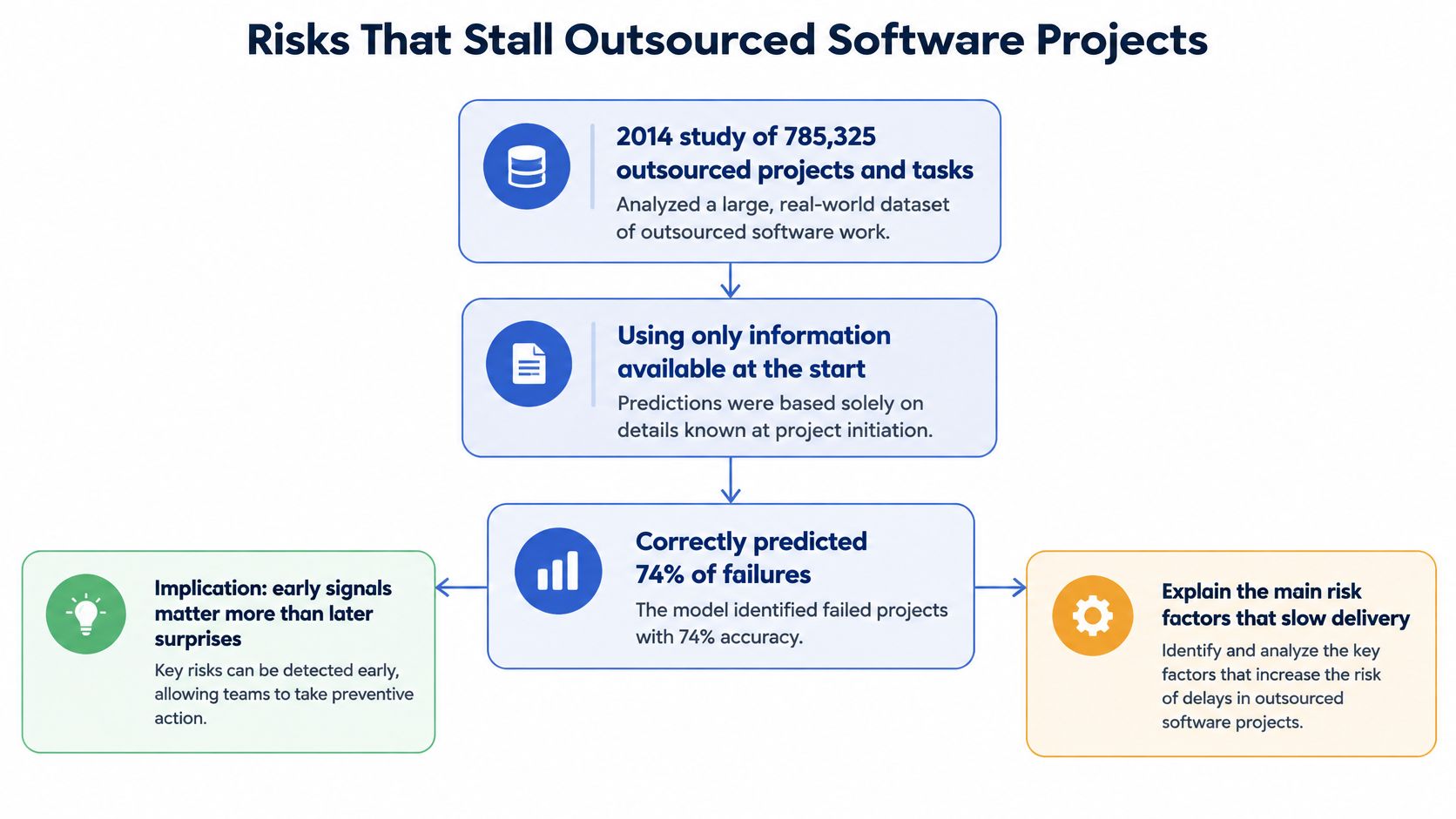
Unclear requirements create a predictable failure path: engineers make assumptions, reviewers expect different outcomes, and rework surfaces late. Buying incentives and the history between client and provider also matter. A 2014 study of 785,325 projects and tasks on the vWorker marketplace correctly predicted 74% of failures using information available when work started.
The study associated previous collaboration and a provider's lower historical failure rate with reduced risk. Risk rose when clients prioritised low price and as projects grew larger. These marketplace findings identify risk factors, not the likely outcome of a particular enterprise programme.
Requirements need decisions, not just documents
A detailed ticket is not a complete specification. Requirements need examples of business behaviour, exceptions, permissions and acceptance criteria. For inherited software, they should also explain which existing behaviours are intentional.
Ask the provider to show how an ambiguous requirement becomes an agreed decision, then a test and a release. If the buyer cannot trace that chain, a polished proposal offers little protection.
Watch for these early warning signs:
- Uncontrolled requirement changes. New requests arrive without an owner deciding what gets deferred.
- Missing client authority. No one on the client side can resolve conflicting stakeholder requests.
- Unproven domain understanding. The provider cannot explain comparable operational risks or provide relevant evidence.
- Rate-led selection. The buying process rewards the lowest hourly rate without accounting for verification, coordination and recovery work.
Working-hour overlap is an engineering constraint
A study of globally distributed delivery surveyed 80 practitioners and associated greater time-zone separation with higher coordination costs, more communication problems, greater schedule pressure and weaker quality outcomes. The findings support examining collaboration arrangements; they do not show that geography alone determines success.
Before signing, specify overlapping working hours, incident-response obligations and which decisions need live discussion. Written design reviews and decision logs support asynchronous work, but some issues still need a conversation.
A UK founder with five hours of overlap with a team five time zones away schedules a 30-minute weekly design review. The meeting helps only if unresolved choices arrive in advance with options, consequences and a named decision-maker.
For inherited platforms, assess legacy system migration against data dependencies, business exceptions and release sequencing. These demands can shape the engagement model and require focused collaboration from the outset.
Delivery Metrics to Track Every Week
A delivery metric is useful only when its definition, source events and owner are clear. Track a small set of measures that connects code changes to production outcomes:
| Metric | What it measures | How to track it |
|---|---|---|
| Change lead time | Time from code committed to successful production deployment | Weekly median and trend over several weeks |
| Deployment frequency | How often changes reach production | Count per week for each product |
| Failed-deployment recovery time | Time to restore service after a failed release | Elapsed time from the failed deployment to restored service |
| Change-fail rate | Share of deployments needing a hotfix or rollback | Failed deployments divided by total deployments |
| Deployment rework rate | Share of deployment work redone after release | Classify corrective deployment work and track alongside change-fail rate |
DevOps Research and Assessment (DORA) provides a production-centred vocabulary. Its metrics history and 2017 State of DevOps findings report change-fail rates of 0–15% for high performers, compared with 31–45% for low performers, approximately a fivefold difference at the range midpoints.
These figures concern deployment failure exposure, not the share of all software containing defects. They help separate the volume of changes from the ability to release them safely. Ticket closures, developer hours and sprint velocity can rise even as production reliability declines.
Establish a repeatable review
A weekly review should connect implementation, release and operational evidence:
- Agree the baseline during mobilisation. Define each metric's start and end events, production boundary and data source before interpreting changes.
- Record weekly figures in a shared view. Separate products with different release processes rather than combining them into a misleading total.
- Review trends across several weeks. Annotate significant incidents, migrations and release freezes so the team can interpret changes.
- Tie acceptance to working production behaviour and escaped defects. A closed implementation ticket alone does not establish operational readiness.
Each figure needs a named owner who can explain how it was calculated. If recovery time improved because the team changed its incident classification, the result reflects a reporting change, not an engineering improvement.
Track collaboration latency alongside delivery measures. Record how long blocked requests wait for decisions and how quickly incidents reach someone authorised to act. That evidence helps separate engineering delays from unanswered client questions.
Demand a delivery record that can be inspected
The buyer needs a shared record of requests, current status, release history and open defects. Release records should identify what changed, which checks passed and who approved deployment. Task completion alone leaves production risk out of view.
Grail Computer Labs gives customers a dashboard for requests, status, communication and release history, while its engineers control the Software Factory. For traffic routing during releases, GoReplay's guide to HTTP traffic routing for DevOps teams offers implementation context. Treat routing configuration as part of the release path, with an accountable owner and a tested recovery procedure.
Measurement discipline: A metric deserves attention when the team can explain its definition, inspect its underlying events and act on the result.
Use DORA's historical ranges as context, not as contractual targets. Product risk, release size and operating conditions differ, so assess whether the delivery system is improving and whether its results can be explained.
Speed, Stability and AI-Assisted Code
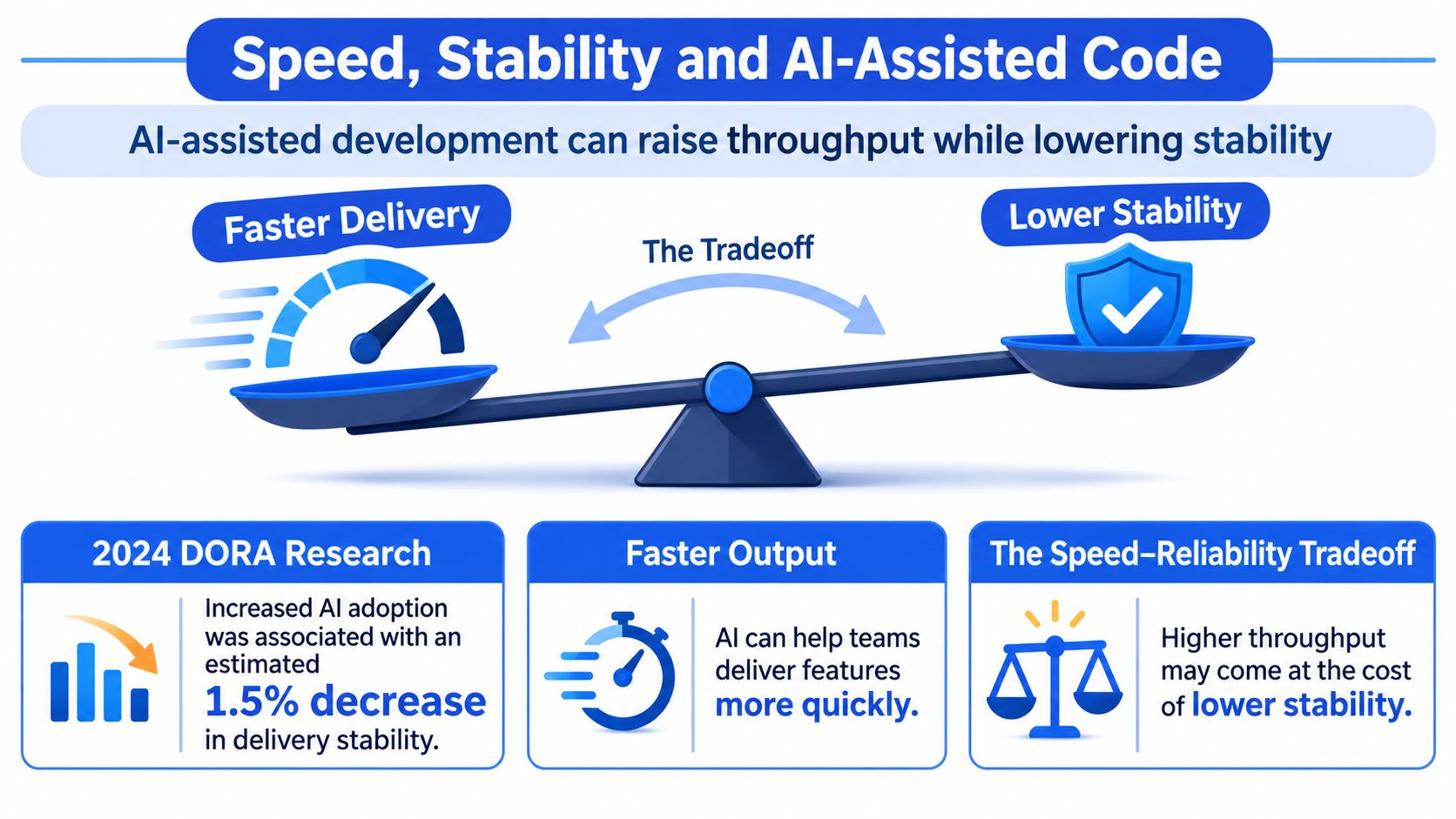
The 2024 DORA report associated increased AI adoption with an estimated 1.5% decrease in delivery throughput and 7.2% reduction in delivery stability. It also reported positive associations with documentation quality, code quality, review speed and approval speed. These findings describe associations, not guaranteed results for a particular team or codebase. (2024 DORA report)
More output needs accountable verification
Suppose a team uses AI agents to increase its change volume. Lead time improves, but change-fail rate rises and corrective work takes up the next release cycle. The added output has raised release risk without delivering a useful speed gain.
Before signing, ask how the supplier will keep verification and release decisions accountable:
- Review ownership. Which engineer reviews each AI-assisted change, and which checks must it pass?
- Business coverage. Which tests exercise business rules, permissions, integrations and complete user journeys?
- Release authority. Who approves production deployment, and who can initiate rollback?
- Decision records. Where are specifications, relevant prompts and model choices retained?
- Success measures. Does acceptance depend on production behaviour, rework and escaped defects, or on generated lines and closed tickets?
Generated tests need independent scrutiny. A test can repeat an implementation's mistaken assumption and still pass. Use this practical guide to verify coverage in AI-generated test cases.
Keep the software development life cycle visible
A controlled software development life cycle (SDLC) traces each change from requirement through review, testing and release. AI-assisted changes need the same accountability as other production changes, with the client retaining ownership of the resulting code, infrastructure and operational knowledge.
Grail's Software Factory processes requests through triage, specification, implementation, review, verification and release. Its agentic software development life cycle describes how those stages can structure AI-assisted delivery. Faster code generation only helps when review, testing and release keep pace.
Ownership, Evidence and Exit Terms to Secure
A provider transition can consume engineering capacity before the replacement team delivers useful work. Missing credentials, unclear deployment steps and unexplained business rules force the incoming team to reconstruct how the product works. The National Law Review's analysis of software project transitions identifies contract gaps, weak vetting and hidden costs as contributors to project failure.
Treat the exit as a knowledge-continuity and control problem. Collect evidence while the outgoing team can still explain its decisions and resolve access issues.
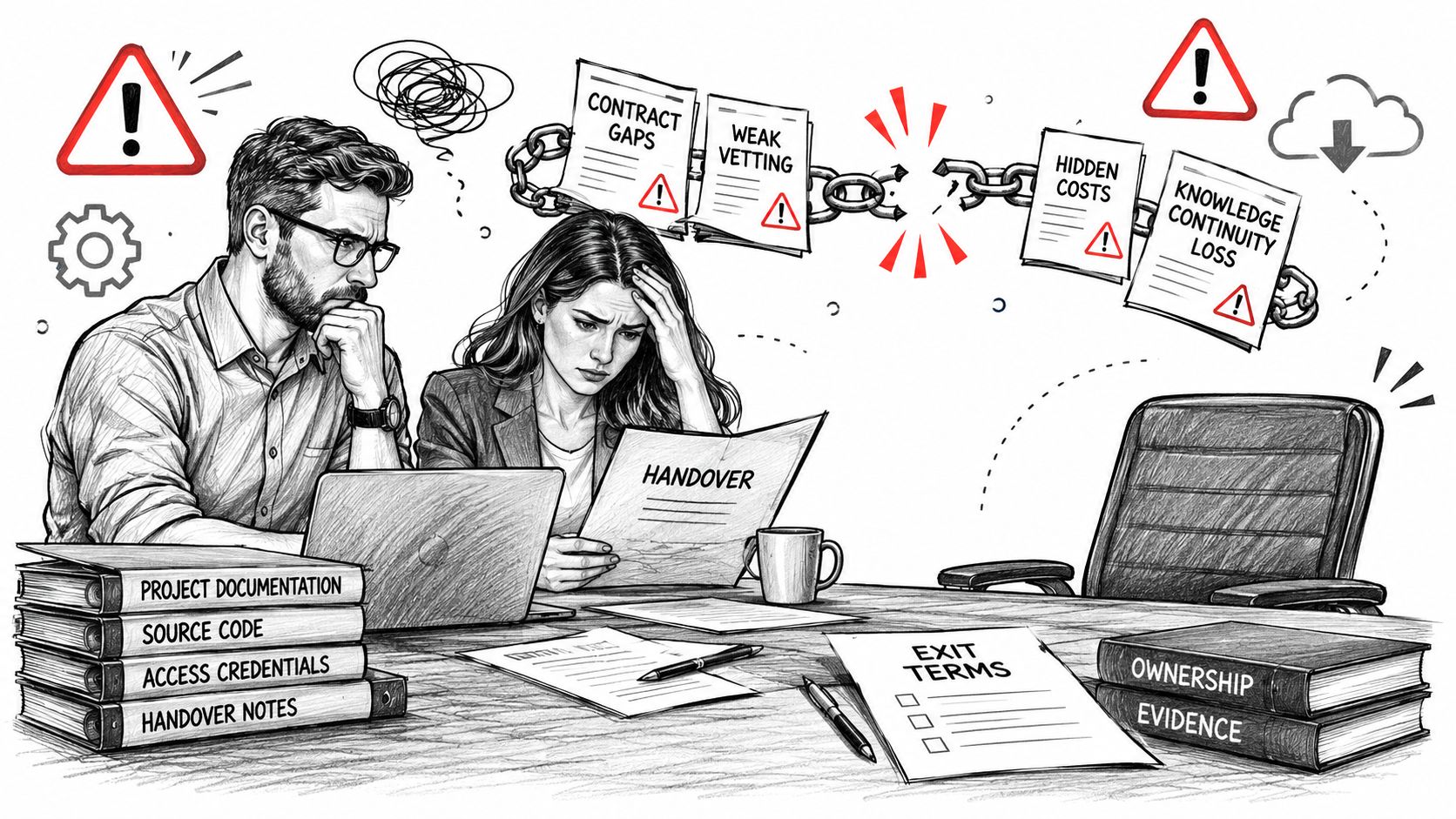
Exit assets to secure before handover
| Exit asset | What to require before the outgoing team leaves | How to verify it |
|---|---|---|
| Source repositories | Full commit history, with access held by the client team | Clone and build on a clean machine |
| Environments and credentials | Every environment and secret transferred or rotated | Confirm the client team can deploy without the provider |
| Deployment history | Release records and rollback steps for each production change | Trace a past release end to end |
| Unresolved defects | Open defect list with severity and known workarounds | Reconcile against the issue tracker |
| Product decisions | Decision log explaining major choices | Ask a new engineer to explain selected decisions |
| Acceptance tests | Automated tests covering business rules, application programming interfaces (APIs) and user journeys | Run the suite and confirm it fails when a rule is broken |
Verification means rebuilding the architecture from the transferred material. The incoming team should build the application and demonstrate a controlled deployment. Add any dependency on an outgoing engineer's private account or undocumented command to the transition risk register.
Turn security promises into obligations
The US National Institute of Standards and Technology software supply-chain guidance provides a basis for expressing supplier requirements through the Secure Software Development Framework (SSDF). Specify the evidence the supplier must provide, such as a component inventory, testing records, release history, rollback procedures and periodic attestation.
The contract should also define customer access to source code, build configuration, deployment instructions and operational documentation. NIST guidance is not a universal contract template. Engineering and legal owners should tailor these obligations to the platform's risk and regulatory setting.
Preserve useful knowledge during software rescue
A rebuild should retain sound business behaviour while replacing the implementation that no longer serves the product. In an Australian healthcare platform takeover, Grail Computer Labs kept useful data, business rules, workflows and operational knowledge while rebuilding the software around them. The rebuilt platform has more than 700 automated test files covering business rules, APIs, database changes, long-running work, browsers and complete user journeys.
Before signing, ask how the provider will audit inherited code, data, infrastructure and product documents, and how it will prove that another team can operate the result. For ongoing application management services, put ownership of code, cloud accounts, models and documentation in writing, and require evidence that those assets are accessible and usable by the customer.
Confirm the Model and Evidence Before You Sign
The buying decision should produce an executable control plan, not just a signed proposal. A useful pre-signing sequence connects commercial structure with engineering evidence:
- Classify the work. State whether the scope is fixed, exploratory or a single measurable outcome, then choose the corresponding model.
- Confirm working-hour overlap and incident response obligations. Include the people authorised to make product and production decisions.
- Define the delivery baseline. Agree how lead time, deployment frequency, recovery time, change-fail rate and rework will be recorded.
- Write the AI controls, naming review, approval and rollback owners. Include access restrictions and the location of decision records.
- Attach the exit-asset schedule. State which evidence must exist before handover and how the receiving team will verify it.
Distinguish a capacity gap from a rescue
A stable scope with an internal team able to own architecture and operations may need a simpler contract, not software rescue. Adding a broad managed relationship where a bounded project would suffice creates unnecessary coordination.
A stalled build needs a different allocation of responsibility. GC Labs offers a takeover service that assumes responsibility for the existing product, codebase, infrastructure, testing and production. Its speciality is software rescue, replacing underperforming vendors and moving stalled AI and software projects that matter but couldn't move; it also builds custom AI models, automates internal operations and re-platforms legacy software.
The final decision rule is straightforward: sign when the evidence list is agreed, not when the proposal looks good. The agreement should make delivery inspectable and a future transition workable.
Grail Computer Labs offers software rescue and outcome engagements for stalled platforms, with continuous delivery available afterwards. Visit Grail Computer Labs to book a scope-review call or discuss an outcome engagement with a 15-day trial, where qualified clients can stop within the first 15 days without paying.