Product Development Outsourcing: Trade-offs and Questions
Product development outsourcing explained: the model, its trade-offs, and the ownership, continuity and delivery questions to settle before you hire a partner.
Most advice on product development outsourcing starts with location and the hourly rate. That advice answers the wrong question first. The decision that matters is who owns the product when the relationship changes, and whether another team could run it next month.
A founder, a CTO or an operations lead usually arrives here for one of two reasons. The in-house team cannot supply the engineering the roadmap needs, or a build with the current provider has stalled and nobody can name a ship date. Private equity (PE) owners, and managed-service businesses (MSPs), non-IT service firms that run a multi-party platform, feel the same squeeze when a customer platform sits between a signed deal and a live service.
A lower rate does not fix unclear ownership. Decision rights and a workable exit do. What follows treats the choice as an ownership decision before it is a cost decision, and it sets out a takeover test a buyer can run before signing.
What Product Development Outsourcing Really Covers
The product needs more engineering than the people on the payroll can give, or the current build has stopped and the deadline has gone vague. Both problems look like a hiring gap. They are not always the same gap.
Product development outsourcing means handing part or all of product engineering to an external team that designs, builds, tests and releases software for the buyer. The range is wide. One end is a single feature with a set end date. The other is a team that owns a product's backlog, releases and production support for years.
Yes, this is a large and established part of the global engineering-services market, not a niche cost tactic. One Mordor Intelligence estimate places global engineering-services outsourcing at USD 164.71 billion in 2026, and it puts product engineering at 29.02% of the market in 2025, the largest service category in that estimate. Sources disagree widely on market size and define engineering services differently, so use the figures for direction only.
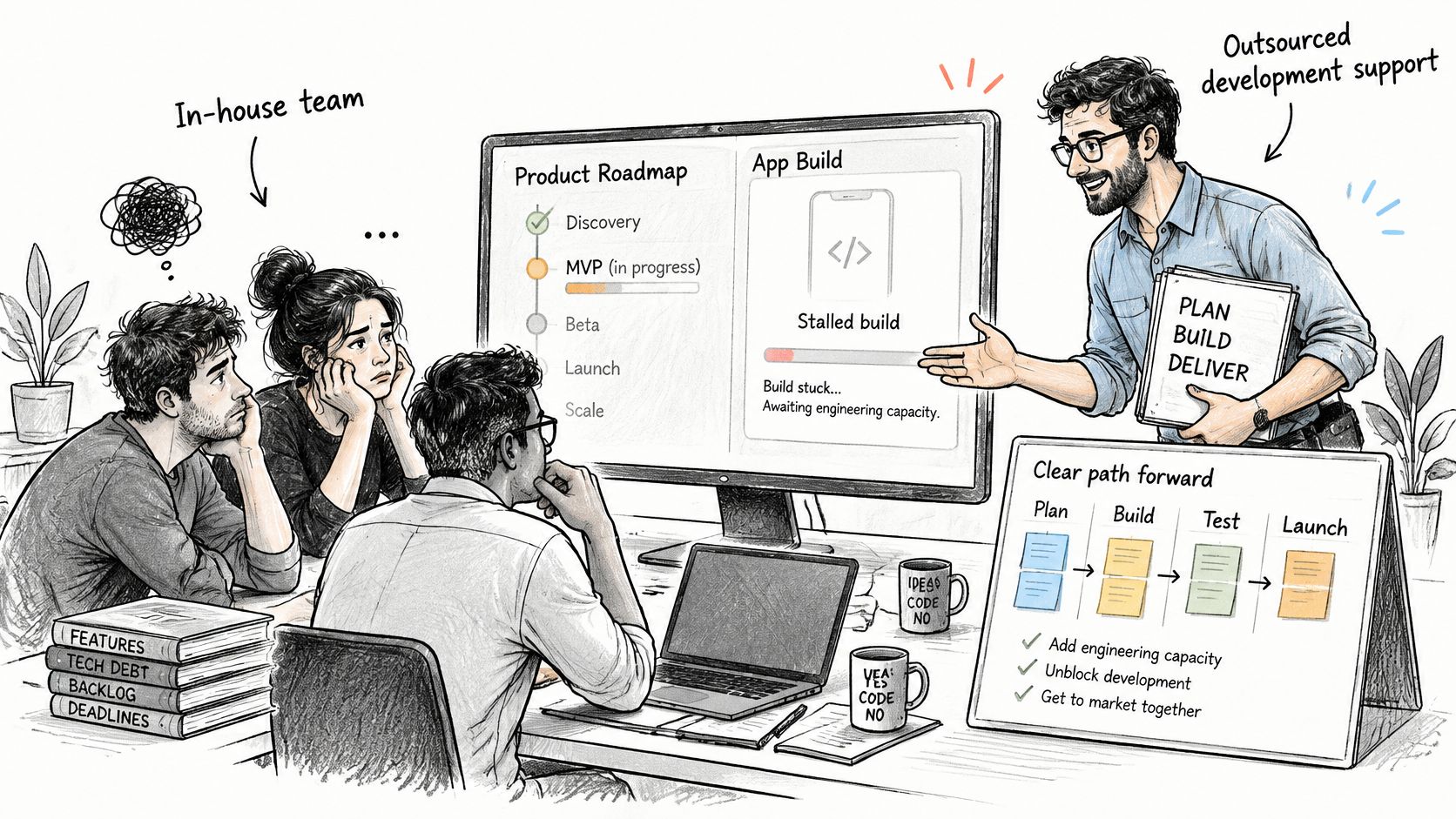
Before comparing models, name the gap.
- Capacity: the roadmap is clear and the current team is full.
- Capability: a missing skill is blocking a release.
- Control: the product is no longer under the buyer's control.
Each answer points to a different model.
Engagement Models Compared Side by Side
Buyers usually choose among five models. The useful comparison is not the rate card. It is who holds the codebase, who makes product calls, and where the model breaks after the first month. Each row trades control against flexibility.
| Model | Who owns the codebase | Who makes product decisions | Best fit | Main risk |
|---|---|---|---|---|
| Project-based build | Supplier during the build, then buyer | Buyer, through change requests | Well-defined features with stable requirements | Scope disputes when requirements shift |
| Dedicated team billed by time | Buyer | Shared, often unclear | Long roadmaps that need flexible capacity | Cost drifts when priorities are unclear |
| Retained team on a monthly commitment | Buyer, with the partner operating it | Shared, with named engineers making product calls | Ongoing backlog, releases and support | No written exit and handover plan |
| Software rescue and takeover | Moves to the new team after an audit | New team, once a recovery plan is agreed | Stalled or failing products | Gaps in inherited code, access and documentation |
| Individual specialists added to your team | Buyer | Buyer | One specific skill gap | Knowledge stays with individuals who may leave |
How to read every row
A project-based build suits stable requirements, but every change request moves risk back to the buyer. A team billed by time gives flexibility, yet it needs a product owner who sets priorities every week. A retained team on a monthly commitment keeps the same engineers across the backlog, releases and production support, which suits a product that keeps changing. Software rescue, or a takeover, starts with an audit rather than a build, and it suits a product stalled with a previous provider. Individual specialists fill one skill gap, but the knowledge often leaves with the people who hold it.
Reading rule: Ask who makes product decisions in week twelve. If the answer is unclear, the model is probably not the right one, whatever the rate card says.
Where control slips
Fixed scope looks tidy until the second change request lands. Time-based capacity looks flexible until nobody can say which story matters this week. A retained team looks closest to an in-house group, and it still fails if exit and handover are not written down before month one. Specialists are easy to add, and they are also the easiest knowledge to lose, because the design often lives in one person's head.
The table describes typical patterns, not fixed terms. Contracts vary by provider and by region, so read the ownership column against the actual draft, not against a sales summary. Buyers who want a second checklist for partner selection can vet consultants for faster software delivery before they shortlist anyone.
Trade-offs That Shape Cost and Delivery Risk
Teams are surprised because the cost of an external team is rarely the number on the rate card. Rework, waiting and missing context change both the bill and the release date. Five trade-offs do most of that damage.
| Trade-off | What goes wrong | Control to put in place |
|---|---|---|
| Time zones and language | Questions wait a day and assumptions go unchecked | Shared overlap window, written decisions, recorded walkthroughs |
| Lower hourly rates | Rework and late releases erase the saving | Compare cost per accepted feature, not per hour |
| Thin knowledge transfer | Only one or two people understand the design | Shared repository, decision records, a named second owner per module |
| Late integration | Separately built parts fail to fit together | Continuous integration, shared interface contracts, joint prioritisation of risky requirements |
| Fragmented accountability | Nobody controls the path to production | One named owner for each release path |
Delay, rates and missing context
Time zones and language add delay because a question can wait a day, and an assumption goes unchecked until the build is already wrong. The control is an agreed overlap window, written decisions and recorded walkthroughs. A lower hourly rate can vanish the same way. Compare cost per accepted feature, not cost per hour.
Knowledge transfer fails without notice. An empirical study of distributed software development found language differences, insufficient informal communication, mismatched infrastructure, processes and goals, and inadequate knowledge transfer each in 88% of the cases it reported. One shared repository, a decision record and a named second owner per module stop that knowledge sitting with one person.
Integration and the release path
Late integration shows up when separately built parts do not fit. A matched survey of 60 outsourced information-systems projects linked continuous integration and joint decision-making with better outcomes, and the effect was stronger when requirements risk was high. Shared interface contracts and joint prioritisation of risky requirements make that finding operational.
Weak accountability is the last trade-off. Product context sits in meetings, release responsibility is unclear, and nobody controls the whole path to production. Grail Computer Labs' delivery model is built for that split, with engineers keeping product judgement while the work moves. A written route through the agentic software development life cycle makes each release check visible instead of verbal.
One named owner for each release path covers more of this table than a lower rate does.
Ownership and Continuity Terms to Agree First
Set these terms before the first sprint. The buyer needs them most when the relationship changes, not when it starts smoothly.
What to hold from day one
Hold the assets from the start, not at termination.
- Source repositories: full commit history, in an organisation the buyer controls.
- Cloud accounts and infrastructure configuration: the buyer is the account owner, not a guest.
- Credentials: stored in a vault the buyer controls, with named access.
- Documentation and runbooks: how to deploy, roll back and support the product.
- Decision log: why choices were made, not only what shipped.
- Evaluation data: where the product uses models, the sets used to judge them.
Add a software bill of materials (SBOM). NIST software supply chain guidance treats the SBOM as an acquisition control. It recommends making SBOMs available for purchased, open-source and internally developed software, and requiring sub-tier suppliers to produce, maintain and provide them whenever practical. Write the update frequency into the contract and into each release. An SBOM does not prove the software is secure. Vulnerability management, patching and access control still sit with the buyer. Broader supplier checks are set out in IT vendor management practices for 2026.
Records when agents write code
For AI-assisted work, require a delivery record on every change. That record covers requirements, design rationale, human review, test evidence, security checks and rollback steps. Automated agents can execute tasks. A named engineer should own product judgement and risk acceptance.
GC Labs engineers stay in that loop wherever product judgement, risk ownership or customer context is required. Agents execute, and humans decide. A faster stream of generated code is not a benefit if the buyer cannot explain, audit or replace it.
Running the product after a handover is a separate job from building it. Application management services only work if the accounts, runbooks and decision log already belong to the buyer.
The exit test
Write down how long an internal team would need to deploy and run the product without the provider. Treat an answer of several weeks as a gap to close before more scope is added.
Say a workforce platform has a release next month. If only the external team can deploy it, the contract has not transferred the product. It has rented access to it. This is a planning test, not a benchmark, and it will not match every codebase. Use it to find missing access, not to score the provider.
How to Take Over a Stalled Product Safely
A takeover keeps what works and rebuilds what does not. The buyer's first decision is about ownership: who can access the system, make recovery decisions, and release changes? Cost matters, but a low monthly rate cannot compensate for unclear responsibility or a product the buyer cannot operate after the engagement.
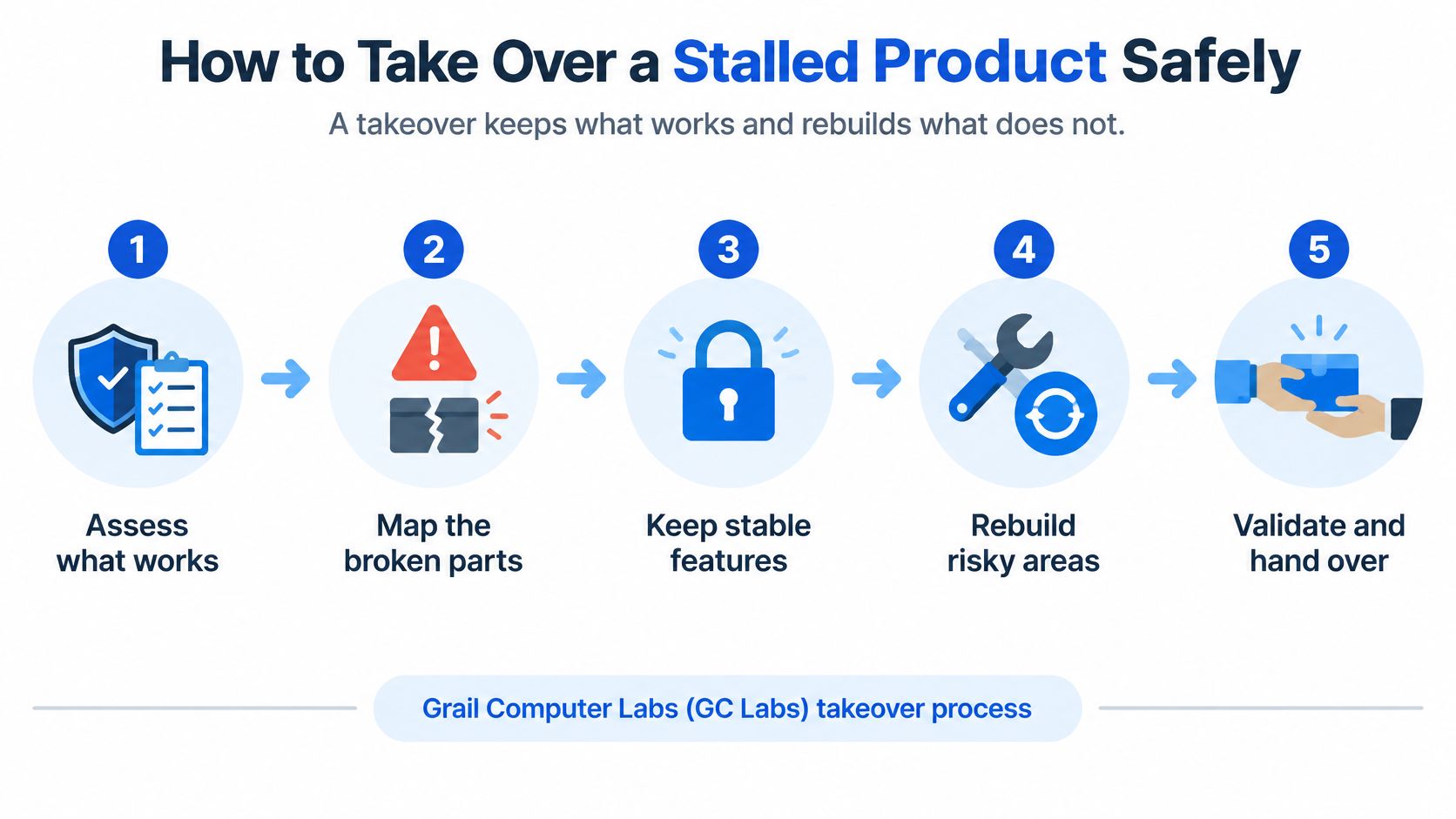
Use this checklist before signing a long contract. It tests whether the provider can take responsibility for inherited work, not whether it can promise a recovery date.
- Name one accountable owner on each side. A stalled product needs someone who can make decisions and someone responsible for acting on them. Without that clarity, status meetings can continue without resolving blockers.
- Audit the inherited system. Grail Computer Labs audits code, data, infrastructure and product documents left by the previous provider before rebuilding. The findings define what can be retained, what needs repair and what remains unknown.
- Secure access and control. Confirm who owns the repositories, cloud environments and build pipeline, and who can grant access. The incoming team needs enough access to assess, change and release the product.
- Map critical workflows. Inventory the system, then trace the paths the business depends on, from sign-in to the outcome a customer needs. A legacy system migration assessment should account for those workflows before changes risk interrupting them.
- Review test coverage and unresolved defects. Base the recovery plan on what can be tested and demonstrated, not on a polished demo. Put unknown defects on the scope list before estimating dates.
- Agree on a prioritised recovery plan. Choose one production-critical capability as the first outcome and define how the buyer will verify it. Defer other work until that capability is live.
- Test the working relationship before expanding scope. A short outcome engagement can target one measurable result over 4 to 8 weeks. Use the result to judge delivery and ownership before committing the wider backlog.
A sound takeover assessment establishes access, accountable owners and a dated recovery plan. It also identifies what remains uncertain, so the buyer can decide whether the team and terms are right before handing over more responsibility.
What a Rebuild Looks Like in Practice
A rebuild is not a clean-slate exercise. Its value depends on preserving the business rules and workflows that still work while replacing the software that blocks production.
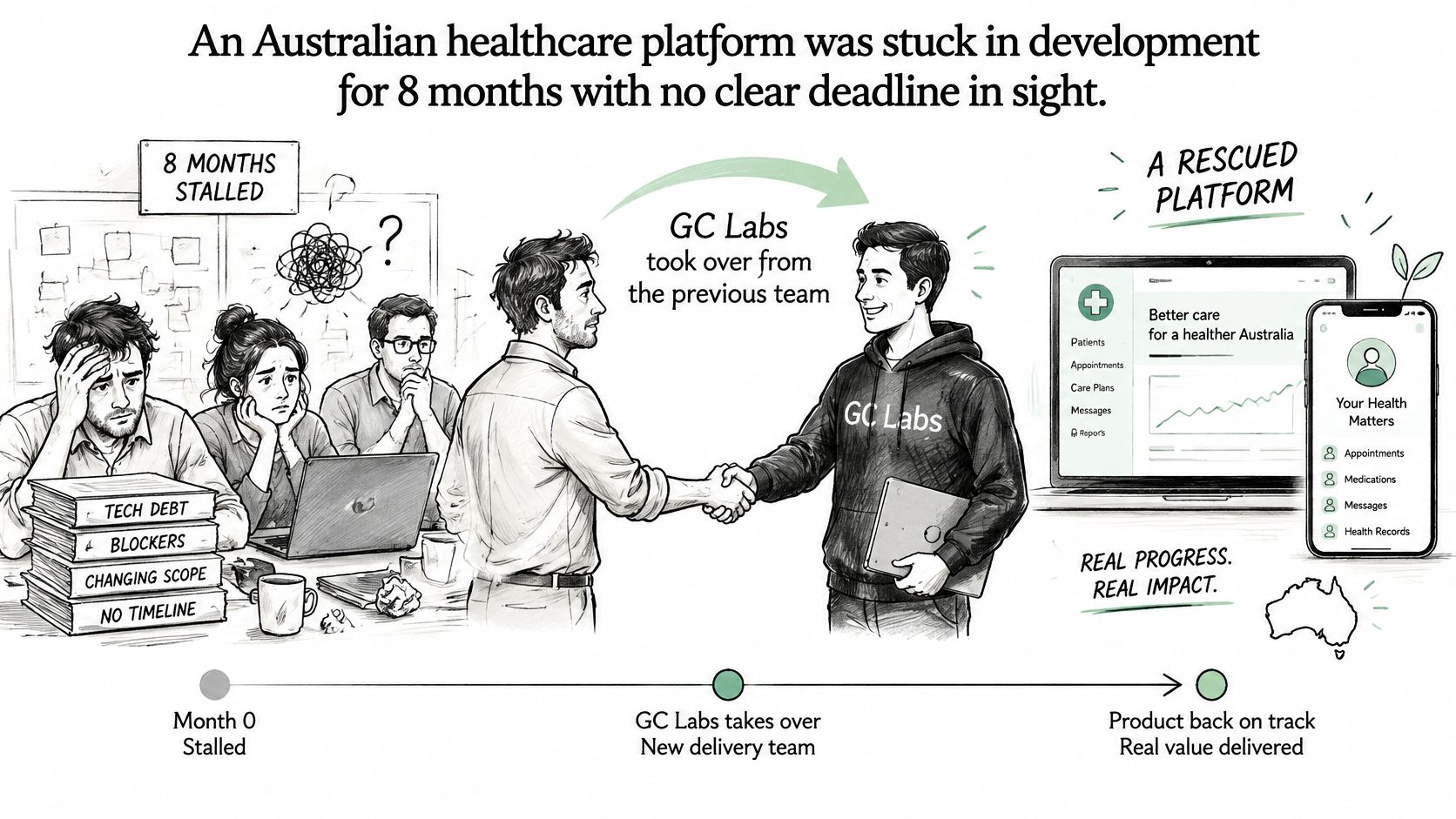
Grail Computer Labs took over an Australian healthcare platform that had been stuck in development for 8 months with no clear deadline. The inherited system included three codebases and 32 .NET projects: a Vue 2 web portal, a separate .NET and Razor onboarding product, and a custom Node sign-in service. Grail rebuilt the platform and had it live in production within 30 days. By day 40, it had onboarded 100 business customers.
What was kept and what was rebuilt
Grail kept useful data, business rules, workflows and knowledge of how the company operated, then rebuilt the software around those facts. An audit of the inherited platform comes first: code, data, infrastructure and product documents help identify what can be retained. Rebuild without that understanding, and working business logic can be lost along with broken code.
A separate result came from testing a Singapore-based neobank product. In a one-week build, automated approvals increased from 44% to 90% in testing. The change was measured in testing, not in live traffic.
An illustrative portal
Hypothetical example: A firm has a stalled customer portal. Before work begins, the audit identifies which customer workflows still function, which modules fail during release, and which accounts or documents were not handed over. The rebuild can then preserve the surviving rules and replace the parts preventing a reliable release.
What this does not prove
The 30-day rebuild shows what happened on this platform, not what another inherited system will take. Delivery depends on the condition of the code and whether the team has the access needed to work. Grail stayed on as the healthcare company's technology partner after the rebuild, handling new features, bugs, infrastructure and production support. That ongoing work continued ownership beyond the initial release.
Choose the Model and Next Step Before You Sign
Choose an outsourcing model by asking how the work can be handed back, then consider cost. The right arrangement should make ownership of the product, decisions, and release path clear.
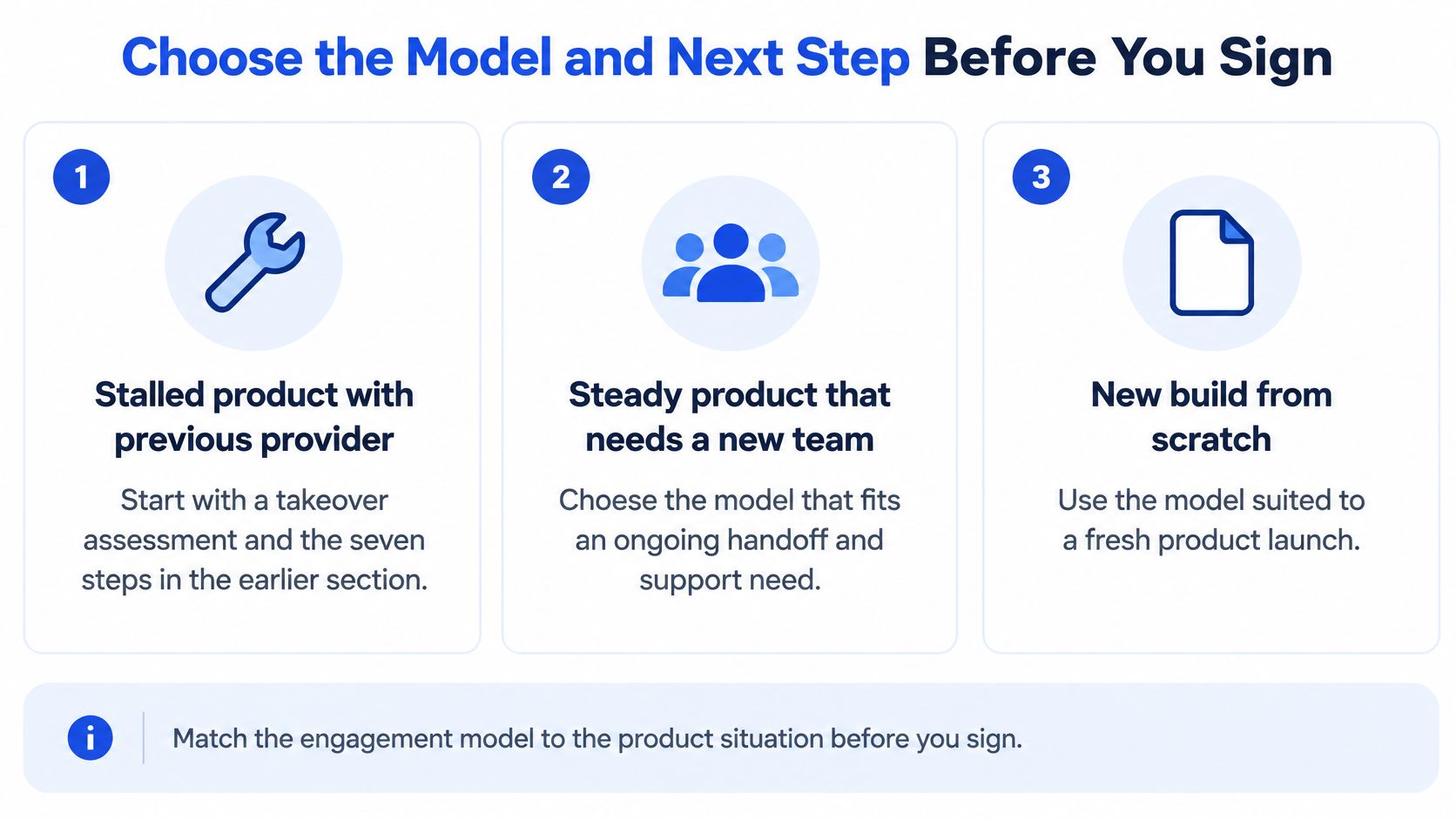
Before signing, ask the prospective team to show how a new engineer or another provider would understand the product and continue the work. Check that the code, operating context, decisions, and release process remain accessible to your company. For a stalled product, use the takeover assessment described above to establish what the team will own and what needs to happen first.
Acceptance before the first sprint
Agree on measurable acceptance criteria, milestones, and an escalation path before work starts. Peer-reviewed reporting of Standish Group 2020 project data reports that 31% of software projects completed successfully, 50% completed with difficulty, and 19% failed. These broad figures provide context, not a prediction for your engagement. Use them to make delivery controls explicit.
This week, gather the current product brief, decision records, repository access details, and release requirements. Then ask the team to explain what it would need to take over the work, how it would report progress, and what your company would retain if the engagement ended.
Grail Computer Labs offers outcome engagements with one predefined, measurable outcome delivered in 4 to 8 weeks. Qualified clients can stop within the first 15 days without paying. After the outcome, continuous delivery keeps the same team responsible for ongoing work at a fixed monthly cost, while the client owns the code, cloud, models, and documentation.
Grail Computer Labs specialises in rescuing stalled software and AI projects and moving them into production. If your key concern is whether another team could take over without losing product knowledge, book a call with Grail Computer Labs.